 SEGLY
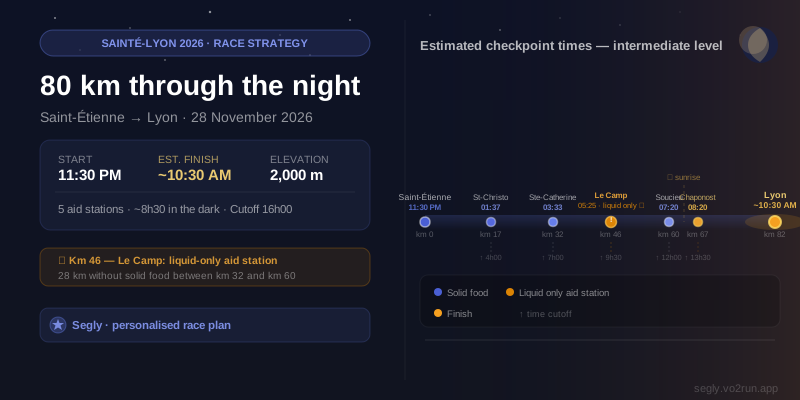
On Saturday 28 November 2026 at 11:30 pm, thousands of headlamps will set off from Saint-Étienne to reach Lyon through the night. Around 80 km, 2,000 m of elevation gain, late-November cold: the SaintéLyon does not forgive improvisation. Here is how to prepare your race, aid station by aid station.
SaintéLyon 2026 in numbers
- Start: Saint-Étienne, Saturday 28 November 2026 at 11:30 pm
- Finish: Lyon, at km 82
- Distance: approximately 80 km (course changes every year)
- Elevation: at least 2,000 m D+
- Aid stations: 5, including one liquid-only (km 46)
- Final cutoff: 16 hours of racing
The official 2026 course has not yet been published. This article is based on the aid stations and cutoffs announced by the organisation, and will be updated as soon as the GPX is released.
The course in 6 segments
The simplest way to digest 80 km of night running: think from aid station to aid station.
| Seg. | From → to | Distance | Aid station | Cutoff |
|---|---|---|---|---|
| 1 | Saint-Étienne → Saint-Christo-en-Jarez | 17 km | Solid food | 4h00 |
| 2 | Saint-Christo-en-Jarez → Sainte-Catherine | 15 km | Solid food | 7h00 |
| 3 | Sainte-Catherine → Le Camp (Saint-Genou) | 14 km | ⚠ Liquid only | 9h30 |
| 4 | Le Camp (Saint-Genou) → Soucieu-en-Jarrest | 14 km | Solid food | 12h00 |
| 5 | Soucieu-en-Jarrest → Chaponost | 7 km | Solid food | 13h30 |
| 6 | Chaponost → Lyon (finish) | 15 km | Finish | 16h00 |
How long does it take to finish the SaintéLyon?
An intermediate-level runner can target around 11 hours, arriving in Lyon around 10:30 am on Sunday morning.
| Checkpoint | Km | Race time | Estimated arrival | Buffer / cutoff |
|---|---|---|---|---|
| Saint-Christo-en-Jarez | 17 | 2h07 | Sun. 01:37 | +1h53 |
| Sainte-Catherine | 32 | 4h03 | Sun. 03:33 | +2h57 |
| Le Camp (Saint-Genou) | 46 | 5h55 | Sun. 05:25 | +3h35 |
| Soucieu-en-Jarrest | 60 | 7h50 | Sun. 07:20 | +4h10 |
| Chaponost | 67 | 8h50 | Sun. 08:20 | +4h40 |
| Lyon (finish) | 82 | 11h00 | Sun. 10:30 | +5h00 |
These times assume that cutoffs are durations from the start and incorporate a gradual pace decrease. They will be recalculated with the official course.
To get your own checkpoint times based on your level and the day's weather, create your SaintéLyon plan in Segly.
Managing the night and the cold
The SaintéLyon is as much about managing cold and darkness as it is about the legs.
The headlamp
- A powerful headlamp and a backup torch, with batteries or a fully charged power bank for the whole night
- Keep the battery warm, against your body: cold reduces its range
Clothing
- Thin layered clothing rather than one thick jacket: you must be able to adapt to each segment
- A waterproof windproof jacket, gloves, a beanie or buff, full-length tights
- Cover up more at aid stations and when walking uphill, where you generate less heat
- Avoid sweating in fast sections: a wet garment will freeze you at the next stop
The coldest points
The coldest hours fall just before dawn, in the second half of the course, when fatigue has set in. Plan your extra layer for that moment. The mandatory equipment list is in the official race rules.
Nutrition and hydration
At night and in the cold, it is easy to forget to eat and drink. It is one of the primary causes of bonking at the SaintéLyon.
- Eat regularly, before you feel hungry: one intake every 20 to 30 minutes, from the first hour
- Drink even without thirst: cold reduces the sensation of thirst, but you sweat as soon as you pick up the pace
- Think about salt: sports drinks, salt tablets or salty foods compensate for what you lose through sweat
- Anticipate km 46: carry your solid food for the 28 km between Sainte-Catherine and Soucieu-en-Jarrest
- Make the most of solid aid stations for a hot drink, without lingering so you don't get cold
- Don't try anything new on race day: gels, bars and drinks must have been tested in training
In Segly, your carbohydrate, sodium and water intake is calculated segment by segment, based on duration, intensity and the forecast weather.
The traps of the SaintéLyon
- Going out too fast. The atmosphere at the start and the stream of headlamps carry you away. Stick to your planned pace for the first 17 km.
- Underestimating cold at stops. Every aid station cools you down. Cover up when you arrive, not when you leave.
- Slippery descents. Mud, wet leaves, possible ice: at night, staying vigilant costs energy and time.
- The long stretch without solid food. 28 km between km 32 and km 60: without supplies on you, the bonk will come.
- The final kilometres. They feel endless with fatigue. A segment plan helps you think only about the next checkpoint.
FAQ
When does the SaintéLyon 2026 take place?
On Saturday 28 November 2026, with a start at 11:30 pm from Saint-Étienne.
How long does it take to complete the SaintéLyon?
It depends on your level. An intermediate runner can target around 11 hours. The final cutoff is set at 16 hours of racing.
Where are the SaintéLyon 2026 aid stations?
At km 17 (Saint-Christo-en-Jarez), 32 (Sainte-Catherine), 46 (Le Camp, liquid only), 60 (Soucieu-en-Jarrest) and 67 (Chaponost), before the finish in Lyon at km 82.
What should I wear for the SaintéLyon?
Thin layered clothing, a waterproof jacket, gloves, a beanie and full-length tights. Check the race rules for the mandatory equipment list.
Is the SaintéLyon 2026 GPX available?
Not yet. The course changes every year: this article will be updated as soon as the official route is published.
Where do I collect my race bib?
At the Halle Tony Garnier in Lyon, on Friday 27 November from 12:00 pm to 8:00 pm and Saturday 28 November from 9:00 am to 5:00 pm.
Your SaintéLyon 2026 plan with Segly
The above is a general estimate. Your plan depends on your level, your confidence on descents and the weather on the night of 28 November.
With Segly, you get in 2 minutes:
- your checkpoint times at each aid station, with your buffer on the cutoffs
- hour-by-hour weather, segment by segment, from 10 days before the start
- your carbohydrate, sodium and water intake for each segment
- clothing advice tailored to your pace and the temperature
- a link to share with your support crew
Key takeaways
- Start on 28 November 2026 at 11:30 pm from Saint-Étienne.
- 5 aid stations over 82 km, including one liquid-only at km 46 (Le Camp).
- 28 km without solid food between km 32 and km 60: carry your food.
- Around 8.5 hours of darkness: plan two light sources and keep your battery warm.
- The coldest points arrive in the second half, when fatigue has set in.
- The official course is not yet published — these times will be recalculated with the official GPX.