 SEGLY
SEGLY
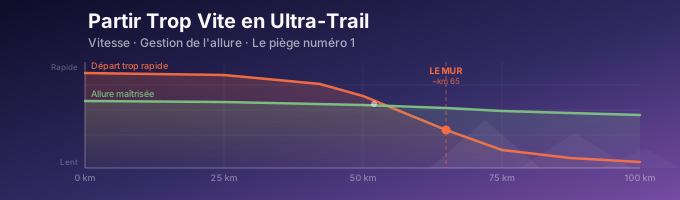
It’s 3 a.m., km 65. You were still walking at km 35—well, you were trying to stop yourself from running. Now you’re crawling. The others are passing you, your GPS is showing paces you no longer dare to look at, and your support person is staring at their phone with that expression you know all too well. It’s not bad luck. It’s not a bad day. It’s exactly what was written in the stars from the start—when you were running two minutes per kilometer off your target pace, and you told yourself it was going to be okay.
Starting too fast is the number one reason people drop out of ultra-trails. Everyone knows it. And everyone falls into that trap.
Why We Always Start Too Fast
It’s not a lack of discipline—it’s physiology and psychology working against you at the wrong moment.
The Adrenaline Rush at the Start
The first few minutes of an ultra are exhilarating. The crowd, the music, the months of preparation culminating in the starting gong. Your heart rate is already at 80% of your maximum heart rate before you’ve even rounded the first corner. In this state, running 10% too fast doesn’t feel like anything—you’ll feel it at the 70 km mark.
The group effect
You start off surrounded by runners who seem to be flying. Your brain interprets their pace as your own. If everyone’s running at this speed, maybe it’s the right one, right? Wrong. The others are starting out too fast, too.
Underestimating the Distance
100 km is an abstract concept. Your body remembers 50 km, 30 km—but not 100. The first 30 kilometers feel like a typical long run. You feel good. So you run at the pace of a long run. Not at the pace of an ultra.
The fear of running out of time
The cutoff is 32 hours; you want to finish in 20—but you’re afraid. Building up a lead early on seems like a good safety net. But the opposite logic applies: a lead built up too early will come back to haunt you in the second half.
Post-workout confidence
You’ve done your 7-hour run; you’ve prepared well. On race day, you feel in great shape. That feeling is real—but it’s misleading in the long run. Fresh legs at the start don’t predict how your legs will feel at the 80 km mark.
What Happens in Your Body When You Start Too Fast
To understand the wall, you need to understand physiology. It’s not some runner’s mysticism—it’s basic biochemistry.
Glycogen depletes faster. Running above your lactate threshold—even slightly—shifts your metabolism to rely on carbohydrates as the primary energy source. Your glycogen stores—about 2,000 kcal, or 3 to 4 hours of intense effort—run out well before the 100 km mark. Once they’re depleted, you can no longer run at that pace. It’s physically impossible.
The lactate threshold gradually decreases. As fatigue builds up, the pace at which you switch to anaerobic metabolism decreases. In other words, what was easy at the 10-km mark becomes difficult at the 50-km mark, and exhausting at the 80-km mark—at the same pace.
Micro-injuries in the muscles accumulate. Every stride causes micro-trauma to the muscle fibers. Starting out fast multiplies these injuries early on, when you could otherwise limit them. The result: inflammation that flares up in the second half, turning every downhill stretch into torture.
The wall. This isn’t a metaphor. It’s the combination of all these factors that causes a sudden and drastic drop in performance—usually between the 60-kilometer and 75-kilometer marks in a 100-kilometer race. Some runners lose 30 to 40% of their speed in just a few kilometers. Not gradually—all at once.
The Data Doesn’t Lie
Studies of UTMB race data show that the further runners deviate from their optimal pace in the first half, the more severe their decline in the second half—and this happens in a nonlinear way. A 5% lead in the first half often results in a 15–20% deficit in the second half.
A concrete example using real data: during the 2026 EuskalTrail 130 km, a runner had planned to finish in 20:59 with a fatigue factor of 15%. At the 72-km mark, he had built up a 1-hour, 2-minute lead over his plan. The result? An actual fatigue factor of 22%—7 percentage points above the plan—and a finish time of 20:57: certainly on schedule, but with a second half that was much harder than expected, and, above all, a wasted margin.
This is the fundamental paradox of ultra running: starting slower often means finishing faster—or at least finishing in the same time but still on your feet rather than completely wiped out.
The paradox of the runner who starts too fast
There’s something counterintuitive about pace management in ultra-distance running: the runner who starts out the fastest isn’t usually the one who feels the most confident. It’s often the one who feels the least confident.
Starting too fast is often a response to anxiety. Anxiety about not finishing in time, about not measuring up, about wasting weeks of preparation. Speeding up at the start is a form of illusory control—I’m running fast, so I’m in control. But you pay dearly for that control several hours later.
The runner who truly masters their ultra is the one who spends the first few kilometers holding back. Who watches the others pull ahead without flinching. Who knows that those same runners will be within reach—and then behind him—in a few hours.
How to Calculate Your Ideal Starting Pace
Here’s a simple four-step method to determine your starting pace.
Step 1: Set your target time
Not your ideal time—your realistic time. Based on your training sessions, your long runs, and your benchmark races. If you’re torn between two estimates, go with the higher one. Humility pays off over 100 km.
Step 2: Choose your fatigue factor
For a first ultra: 20–25%. For an experienced runner with a solid foundation: 15–18%. For challenging conditions (heat, technical terrain, altitude): add 3–5 points. Elite runners at the UTMB run at 9–14%—but forget those numbers for now.
Step 3: Calculate your theoretical pace
Example with a goal of 18 hours for 100 km and a fatigue factor of 20%:
- Target average pace: 100 ÷ 18 = 5.55 km/h
- Pace for the first half: 5.55 × (1 + 10%) ≈ 6.1 km/h
- Second-half pace (slowing down): 5.55 × (1 − 10%) ≈ 4.9 km/h
These average paces should be adjusted for each segment based on the elevation gain of that portion.
Step 4: Create your race plan segment by segment
An overall target pace isn’t enough. On an ultra with 4,000 m of elevation gain, each segment has its own effort-to-speed ratio. A climb at 400 m/h and a descent at 8 km/h cannot be analyzed using the same pace. Our guide to split times in ultra-trail races details this method segment by segment.
6 Practical Strategies to Avoid Starting Too Fast
Knowing the theory isn’t enough. Here are the practical strategies you can implement starting with your next ultra.
1. Turn on your GPS before the start and set a pace alert. Set an alarm if you exceed your target pace by more than 5%. Let technology handle the mental load while you manage your energy.
2. Deliberately position yourself toward the back at the start. Not just a little back—way back. The natural movement at the start will carry you forward. Starting from the back eliminates the temptation to follow groups that are running too fast.
3. Focus on your heart rate, not your speed. On varied terrain with elevation changes, speed can be misleading. Your heart rate doesn’t lie. For the vast majority of ultras, stay below 75% of your maximum heart rate (MCHR) for the first 3 hours.
4. Give your support crew your race plan with a simple instruction: if you arrive at an aid station more than 20 minutes early, they’re to tell you to slow down. No exceptions.
5. Run the first descent at 80% of your maximum effort. Descents are treacherous: they seem easy at the start of the race, but they’ll wreck your quads for the rest of the race. Save your quads for the last 30 kilometers.
6. Test your pace strategy during training. A long run of 5 to 6 hours at your target ultra pace is ten times more useful than a run where you go all out. Training at your target pace takes practice.
What if I’ve already started too fast?
It happens. Even to the best. If you realize at kilometer 30 or 40 that you’ve been running 10 to 15% too fast, here’s how to minimize the damage.
Slow down immediately and drastically. Not gradually—right now. Every additional kilometer at too fast a pace widens the physiological deficit you’ll have to make up for later. The embarrassment of walking at the 40-kilometer mark is infinitely preferable to dropping out at the 75-kilometer mark.
Eat even if you’re not hungry. Low blood sugar sets in before you feel hungry. If you’ve been running fast, your reserves are depleted—start eating again right away.
Walk the next climb. It’s not a waste of time—it’s buying time for later. Climbs are where a racing heart is most dangerous.
Recalculate your split times. Your initial plan is compromised. Recalculate assuming a greater drop in pace—5 to 8 points slower than expected. This honesty will allow you to manage the remaining kilometers without panicking.
Don’t beat yourself up. The present is what matters. A poor first half doesn’t determine the second—but panic, frustration, and abandoning your strategy do.
Conclusion
Starting too fast in an ultra means trusting your momentary impulse over your racing intelligence. It’s human, it’s understandable—and it’s avoidable.
Pace management isn’t a constraint that takes away from the fun. It’s the skill that will let you finish on your feet, run the last 20 kilometers rather than just survive them, and cross the finish line with something that still feels like life in your legs.
Runners who finish strong aren’t the ones who start the fastest. They’re the ones who start the smartest.
Calculate your ideal starting pace and your split times from aid station to aid station. Import your GPX file to segly.vo2run.app, set your fatigue factor, and build the strategy that will let you finish strong—not just start fast.