 SEGLY
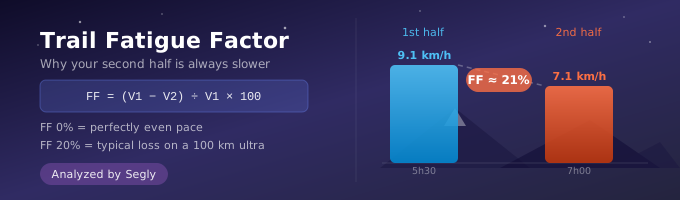
You start on your plan, everything is going well, you reach the first aid station ten minutes ahead. Then, somewhere after halfway, the kilometres start to stretch. Your pace drops, the climbs feel twice as long, and your neat split-time table is no longer any use. This isn't bad luck: it's a measurable phenomenon, and it can be anticipated. It's called the fatigue factor.
What is the fatigue factor?
The fatigue factor (FF) measures how much you slow down between the first and second half of a race, expressed as a percentage of your starting speed.
The formula is simple:
An FF of 0% means you ran at the same speed in both halves. An FF of 20% means your speed dropped by a fifth. The higher the figure, the more the race has "cost" you over time.
A few useful details:
- We're talking about speed, not time. That's what allows a clean comparison between the two halves.
- The cut-off point isn't necessarily the halfway distance. On a course where the elevation gain is concentrated on one side, you choose a point that separates two halves of comparable effort. At the UTMB, for example, our calculations split at 84.7 km.
- It's not a judgement. A high FF doesn't mean "bad runner": it simply says your first half was faster than your second. The only question is whether that was intended.
A worked example
Take a 100 km race. You cover the first 50 km in 5h30, then the next 50 km in 7h00.
- First-half speed: 50 ÷ 5.5 = 9.1 km/h
- Second-half speed: 50 ÷ 7 = 7.1 km/h
- FF = (9.1 − 7.1) ÷ 9.1 × 100 = about 21%
Now let's see what that changes in a race plan. You are capable of holding 10 km/h in the first half and you build your plan around that constant speed:
| Scenario | First-half time | Second-half time | Finish |
|---|---|---|---|
| Constant speed (FF 0%) | 5h00 | 5h00 | 10h00 |
| With an FF of 20% | 5h00 | 6h15 | 11h15 |
A 1h15 error from a single parameter. On a 24-hour ultra, it can exceed two hours. That's the difference between finishing before the cut-off and watching it close in front of you.
Why slowing down is inevitable
Slowing down in the second half isn't a training flaw. It has well-known physiological causes, which add up:
1. Energy reserves running out. The body stores little glycogen. On a long effort, you depend more and more on the energy you take in through food, and your stomach doesn't always keep up.
2. Muscle fatigue, especially from descents. Descents load the muscles while braking (eccentric contractions), which damages them more than climbing does. After several thousand metres of negative elevation, the quadriceps respond less well, and descending pace collapses.
3. Neuromuscular fatigue and technique. When muscles tire, the stride becomes less precise. On technical ground, you lift your feet less, hesitate, and slow down out of caution.
4. Lack of sleep. On an ultra, night arrives when you're already well into the race. Alertness drops, perceived effort rises, and the night slows almost everyone down.
5. Heat, cold and mindset. Bad weather, a dip in morale, a rough patch at the aid stations: each factor weighs a little, and they all accumulate.
The result is that slowing down is not an accident to avoid but a variable to build in. The real risk isn't slowing down — it's not having planned for it.
What are the reference values?
The FF depends on level, distance, elevation gain, weather and strategy. We can still set a few indicative benchmarks.
- Elites keep their loss of speed very low. At the UTMB 2022, Kilian Jornet's FF came out at about 14%, and Mathieu Blanchard's at about 9%.
- Amateur runners often sit well above that, frequently between 20 and 30% on a long ultra, and more when the race goes badly.
- The shorter the race, the lower the FF. On a distance you finish in under 6 hours, the loss of speed is much more moderate than over a 100 miles.
These values are orders of magnitude, not rules. Your own race history is always worth more than an average.
How to find your FF
Three ways to estimate it, from most reliable to most approximate:
Your own past race. Pull up the GPS track of a race of comparable distance, note your speed in each half, and apply the formula. It's the most reliable method, because it captures your profile, your nutrition management and how you handle the night.
A similar race by a runner of your level. If you have no history, take the split times of a runner who finished in your time range in the same event.
A sensible default value. If you're starting out in ultras, planning around an FF of about 15% is a good working basis, to be adjusted later based on how you feel in training.
On your first attempt, it's better to aim slightly too cautious than too optimistic. An underestimated FF means a race plan that has you falling behind your own schedule by kilometre 60, with the mental pressure that comes with it.
What an FF doesn't tell you
The fatigue factor is an average. It hides two important things.
How the slowdown is distributed. Two runners with the same FF of 18% can have very different races: one lost speed gradually, the other held on until nightfall before collapsing. The FF gives the magnitude, not the shape.
The role of the terrain. A second half full of technical descents doesn't cost the same as a rolling second half. That's why the FF alone isn't enough, and why a good race plan works segment by segment.
How to reduce your FF
You can't eliminate fatigue, but you can delay it and cushion it:
- Start more slowly than you'd like to. The strategy that lowers the FF most is not burning your reserves in the first 30 kilometres. Every minute gained too early is often paid back several times over in the second half.
- Eat and drink from the start. Waiting until you're hungry or thirsty is already too late. A written nutrition plan, with what you take at each aid station, avoids nasty surprises.
- Train your descents. This is one of the most effective levers: negative-elevation sessions prepare the muscles to absorb impacts and limit the damage late in the race.
- Use poles intelligently. They take the strain off your legs on climbs and descents, provided you've trained with them.
- Prepare for the night. Headlamp, clothing, aid-station food that's easier to digest: anticipating the night saves time and energy.
- Do long runs at endurance pace. They teach the body to burn fewer carbohydrates and stay below its threshold for hours.
Building your FF into your race plan
The real value of the FF is turning it into realistic split times. Without a tool, the method looks like this: split the course into segments, estimate a base speed for each segment according to elevation gain, apply a gradual slowdown from halfway based on your FF, and manually adjust special sections. It's doable on paper, but tedious and easy to get wrong on a 100 km or longer race.
That's exactly what Segly automates. You import your GPX file, the app splits the course into segments (automatically or by hand), calculates a time per segment taking elevation gain, gradient and altitude into account, then applies your fatigue factor across the whole route. You can set it yourself, and then fine-tune the progression factor of each segment — for example to slow down at night or on a technical section.
On the EuskalTrail 130 (128 km, 6,727 m D+), the preparation was done with an FF set at 15%, compared with elite runners' values, with manual adjustments for the night and for technical sections. Segly's forecast: 20:59. Actual time: 20:57.
A two-minute gap doesn't mean everything will be that precise for you — a race is a race. But it shows what you gain by no longer improvising: you know when you'll slow down, you know by how much, and you can prepare your crew accordingly.
Key takeaways
- The fatigue factor measures the loss of speed between the first and second half of a race.
- Slowing down in the second half is normal: the problem is not having planned for it.
- Leaving it out of your plan can cost you more than an hour over a 100 km.
- Your best starting point is your own history; otherwise, a cautious value around 15%.
- Starting more slowly, eating early and training descents are the three levers that reduce your FF the most.
Applying these concepts to a race
- Grand Trail des Templiers: race plan, split times and strategy
- UTMB 2026: the atmosphere trap and how to run your own plan
- Preparing for the Diagonale des Fous: race plan, segments and strategy
- 2026 Grand Raid des Pyrénées: strategy to finish on your feet
- Échappée Belle 2026: surviving the technical descents
- Ultra du Saint Jacques 2026: building your strategy with Segly
- EuskalTrail 130 — Segly vs the clock: 17 checkpoints, −2 min
- EuskalTrail 130 km: how I built my race strategy
Ready to calculate yours? Import the GPX of your next race into the plan builder, set your fatigue factor, and discover your split times segment by segment, with the PDF export to share with your crew.