 SEGLY
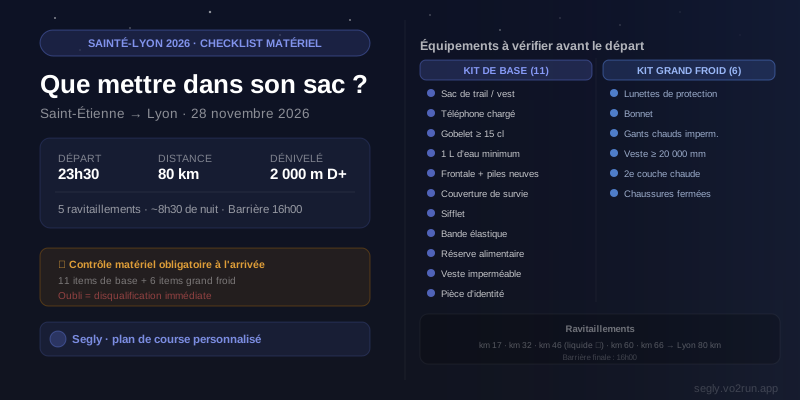
The SaintéLyon 2026 starts on the evening of November 28, at 11:30 PM, from Saint-Étienne. 80 kilometers through the night, 2,000 meters of elevation gain, in November. Before you step onto the start line, the organization checks your gear. One missing item, and you're disqualified.
This guide covers all mandatory gear for the SaintéLyon 80 km, with an aid station breakdown, clothing recommendations, and a complete pre-race checklist.
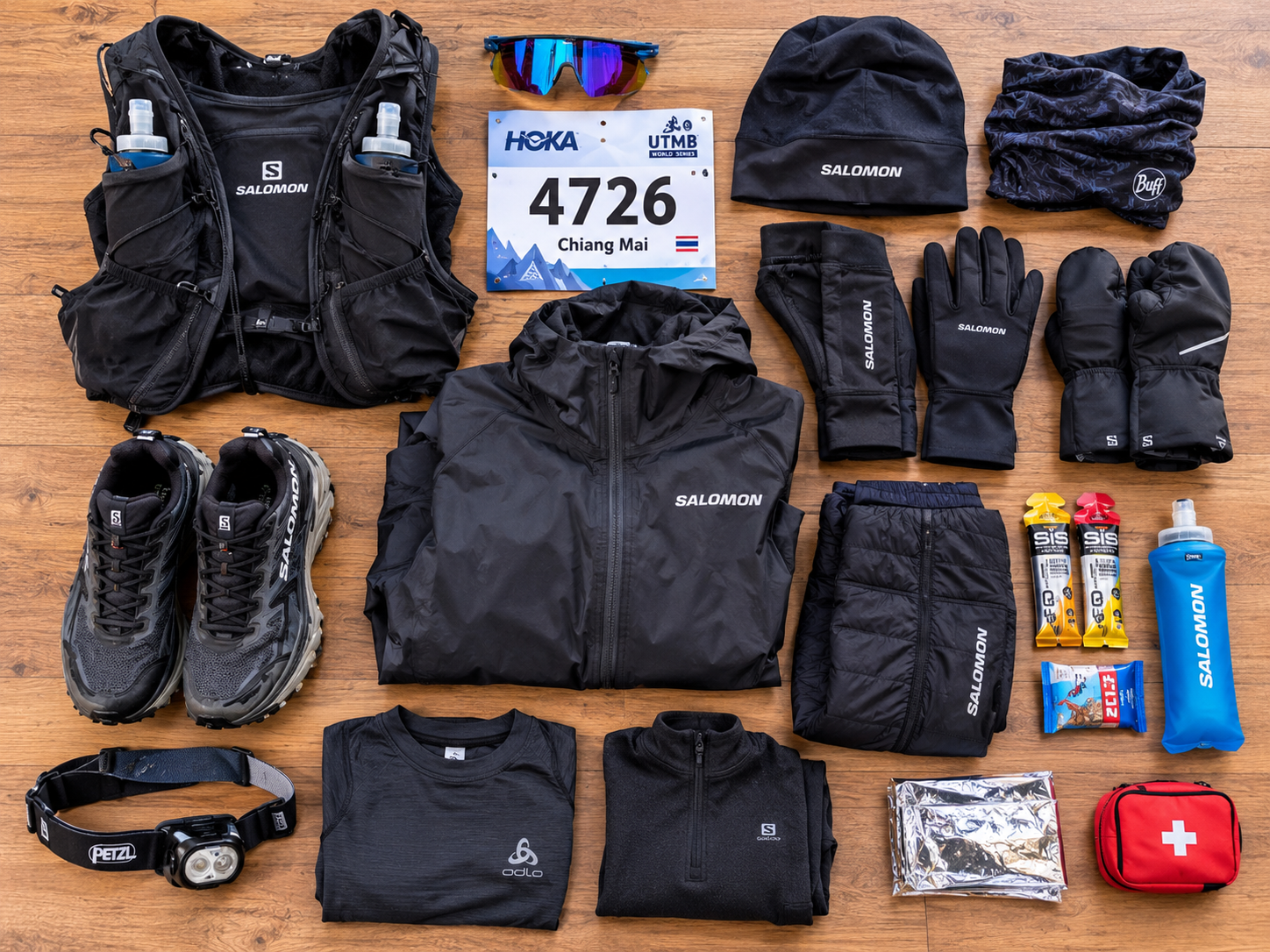
Complete trail kit laid out before the start — the 17 mandatory items for SaintéLyon 2026
The 11 mandatory items — base kit
All 11 items must be present at the gear check. Missing even one means disqualification:
- Trail vest / pack — to carry everything else
- Charged mobile phone — with the race organization number saved
- Rigid cup ≥ 15 cl — aid stations do not provide disposable cups
- 1 liter of water minimum — at the start and between aid stations
- Headlamp + spare batteries — the race runs at night (~8h30 in the dark)
- Emergency blanket — compact, unopened
- Whistle — built into the vest or clipped on
- Elastic bandage — Elastoplast type or equivalent
- Food reserve — in case of an aid station issue
- Waterproof jacket — with hood, taped seams recommended
- ID document — national ID card or passport
The cold weather kit — 6 additional items
In November, the SaintéLyon crosses exposed terrain above 1,000 m elevation. Cold, wind and moisture can be brutal. These 6 extra items are mandatory:
- Protective goggles — against wind and rain
- Beanie — covering the ears
- Warm waterproof gloves — not thin running gloves
- Jacket ≥ 20,000 mm waterproof rating — confirmed waterproofing (separate from the base jacket if below this threshold)
- Second insulating layer — fleece, down jacket or equivalent
- Closed trail shoes — not flat soles or heavily ventilated models
Many runners bring an entry-level jacket that doesn't meet the ≥ 20,000 mm waterproof requirement. If your jacket is rated 10,000 or 15,000 mm, you'll need to bring a second one. Check the label before you leave.
Recommended clothing
Beyond the mandatory gear, here's what many finishers recommend for 80 km in November:
| Body area | Recommended | Avoid |
|---|---|---|
| Top | Technical base layer + light softshell | Cotton, loose T-shirt |
| Bottom | Warm tights + trail shorts | Shorts only, jeans |
| Feet | Waterproof or thick trail socks | Thin road socks |
| Head | Ear-covering beanie + buff | Visor alone |
| Hands | Warm waterproof gloves + thin gloves in reserve | Thin gloves only |
Aid stations: where and what to find
The SaintéLyon 80 km has 5 aid stations between Saint-Étienne and Lyon. Note that Le Camp (km 46) is liquids only — 28 km without solid food between Sainte-Catherine and Soucieu:
| Aid station | Km | Type | Cut-off |
|---|---|---|---|
| Saint-Christo-en-Jarez | 17.1 | Solid + liquid | 04h00 |
| Sainte-Catherine | 32.0 | Solid + liquid | 07h00 |
| Le Camp | 46.4 | ⚠ Liquids only | 09h30 |
| Soucieu-en-Jarrez | 60.2 | Solid + liquid | 12h00 |
| Chaponost | 66.5 | Solid + liquid | 13h30 |
Finish: Lyon Confluence · km 80.6 · final cut-off 16h00
How to organize your pack
A well-organized pack saves time at aid stations and avoids frustration in the dark:
- Main compartment: jackets (base + cold kit), emergency blanket, solid food
- Front pockets: cup, energy bar, elastic bandage, ID
- Belt/chest pockets: phone, gels, whistle
- Immediate access: headlamp on your head from the start
Test your loaded pack on a long training run before the race. A 5–7 liter vest is sufficient for the 80 km in normal conditions; go up to 10–12 L if you run cold or the forecast is bad.
Classic mistakes to avoid
- Underrated jacket: a 10,000 mm jacket won't pass if the organization requires 20,000 mm. Check the label before you go.
- Untested headlamp: change the batteries the night before even if they 'seem fine'.
- Forgotten cup: SaintéLyon aid stations do not provide cups. No cup = no hot drink or soup.
- No food reserve: between km 32 and km 60, the only intermediate aid station (Le Camp, km 46) is liquids only. Pack 2–3 extra bars or gels.
- Too-light shoes: November trails can be muddy and slippery. A lugged outsole is recommended.
Complete pre-race checklist
✅ Base kit — 11 mandatory items
- ☐ Trail vest / pack
- ☐ Charged mobile phone (race org number saved)
- ☐ Rigid cup ≥ 15 cl
- ☐ 1 L of water minimum
- ☐ Headlamp + fresh spare batteries
- ☐ Emergency blanket (unopened)
- ☐ Whistle
- ☐ Elastic bandage
- ☐ Food reserve (bars, gels)
- ☐ Waterproof jacket with hood
- ☐ ID document
🧊 Cold weather kit — 6 mandatory items
- ☐ Protective goggles
- ☐ Ear-covering beanie
- ☐ Warm waterproof gloves
- ☐ Waterproof jacket ≥ 20,000 mm
- ☐ 2nd insulating layer (fleece or down)
- ☐ Closed trail shoes
📋 Recommended (not mandatory)
- ☐ Trekking poles (allowed)
- ☐ Anti-chafing cream
- ☐ Waterproof or compression socks
- ☐ Buff / neck warmer
- ☐ Sunscreen (for the daylight finish)
Personalized split times at every aid station · finish time estimate · cut-off alerts
Create my plan →
SaintéLyon 2026 gear FAQ
- Can I carry the waterproof jacket in my hand, or must it be packed?
- It must be accessible and on you if weather conditions require it. It can be packed, but checkers may ask you to put it on at the start-line gear check.
- Is a collapsible cup accepted?
- Yes, as long as it holds at least 15 cl when unfolded. Soft cups like those from Salomon or Raidlight are accepted.
- Do I need two jackets (base + cold kit) or will one do?
- If your single waterproof jacket meets the 20,000 mm requirement, it counts for both criteria. Otherwise, you need two.
- Are trekking poles allowed?
- Yes, poles are allowed on the 80 km. With 2,000 m of elevation gain and potentially muddy trails, they can be a real asset.
- What happens if I forget a mandatory item?
- You cannot start, or you are disqualified if the check is at the finish. There is no tolerance — every item is verified.
Source: official SaintéLyon 2026 rules — saintelyon.com