 SEGLY
SEGLY
The runner is not the one living through the most stressful moment of an ultra. It's often the person waiting for them at the roadside, phone in hand, watching every bib that goes by for two hours. Here's what crew go through during a race — and how Segly was designed with them in mind.
The scene every crew member knows
It's 11:40. The race plan said the runner would pass this aid station around 12:07. The car has been parked there for an hour already, the spare bag is ready, the food is laid out on the bonnet.
12:07 arrives. No bib. 12:20, still nothing. The mind starts going round in circles: did they have a problem? Did they fall? Did I miss them while I was in the toilets? Should I wait here or head to the next aid station?
Almost anyone who has crewed a runner in an ultra-trail has lived this scenario. And the worst part isn't the waiting itself — it's the total uncertainty about what it means.
Why the starting estimate is never enough
A race plan, however well prepared, gives a theoretical passing time calculated before the start. It's an excellent base — but only a base. On race day, everything moves:
- a climb harder than expected that costs 20 minutes
- a good day that saves 15
- a longer stop than planned at an aid station
- weather that changes the picture along the way
The result: the theoretical time, calculated the night before, loses reliability as the hours go by. And it's precisely this gap, invisible to the crew, that turns a calm wait into a source of stress.
What a poorly informed crew member actually feels
Putting yourself in the shoes of the person waiting means understanding three very specific problems.
The uncertainty of timing. Without an update, there's no way to know whether the runner is early, on time, or late — and by how much. Ten minutes late is nothing. Two hours could mean a dropout or a serious problem.
The fear of missing the pass. Many crew members don't even dare step away to use the toilet or buy a coffee, for fear of missing the runner in a passing window they don't know.
The impossibility of anticipating. Without visibility on the real time, it's hard to know when to pack up, when to set off for the next point, or when simply to relax a little.
This stress is not trivial: a tense crew member who couldn't rest or get organised properly is a less effective crew member just when the runner needs them most.
Organisers' live tracking doesn't always help
Many races now offer a live tracking app or website, meant to reassure the crew by showing a position or an estimated passing time in real time. On paper, that's the solution. In practice, it's rarely that simple.
In the mountains, GPS signal and network coverage are patchy: a runner can disappear from tracking for long minutes in a narrow valley or dense forest, before suddenly "reappearing" further on. The estimated passing time is often calculated on a generic average speed, without taking into account the runner's actual profile or the difficulty of the current segment — it can show a time that doesn't move for an hour, then jump forward twenty minutes all at once.
For the crew, the result is sometimes worse than having no information at all: a signal that vanishes immediately raises fears of a dropout or a fall, an estimate that matches nothing destroys trust in the tool itself, and the reflex of frantically refreshing the page every two minutes adds a layer of stress rather than removing one. Many experienced crew members end up ignoring these trackers altogether, or cross-checking them with their own landmarks — which cancels out most of their value.
How Road Book Assistance addresses this
Segly's Road Book Assistance starts from a simple principle: the race plan shouldn't stay frozen at the start — it should be recalculated continuously from what actually happens on the course.
Concretely, at each checkpoint the runner passes (at a known point on the course), Segly automatically recalculates the estimated time for the next meeting point — and shows the gap compared with the initial plan.
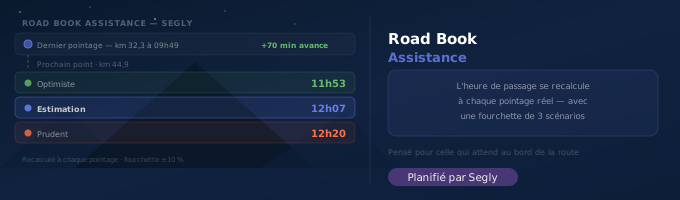
A real example: last checkpoint at km 32.3 at 09:49, with 70 minutes ahead of the planned schedule. For the next point, at km 44.9, Segly shows three estimates rather than a single figure:
| Scenario | Estimated time |
|---|---|
| Optimistic | 11:53 |
| Estimate | 12:07 |
| Cautious | 12:20 |
This range (roughly ±10%, recalculated after each checkpoint) gives the crew a real window to act: they know there's no point worrying before 12:20, and can use that time to rest, eat, or simply catch their breath — rather than staring at the road for an hour and a half.
The difference from an organiser's GPS tracker: Segly doesn't try to locate the runner continuously, but to recalculate a reliable estimate from their own plan and their actual checkpoints. No signal gap that makes you fear the worst, no generic estimate disconnected from the runner's profile — just an updated time, with an acknowledged margin of error rather than false precision.
What it changes, concretely, for the crew
- No more guessing. The displayed time takes into account what actually happened on the course, not just what was planned before the start.
- Real room to manoeuvre. The optimistic/estimate/cautious range shows when it's still normal to wait, and when it's legitimate to start worrying.
- Less time lost on site. Knowing you have 40 minutes ahead is time to grab a quick bite, rest, or calmly prepare the next handover.
- Less mental load. The crew no longer has to do the rough calculation themselves — "he was there at such a time, so he should arrive around..." — Segly does it for them and updates it at every new checkpoint.
Designing the race plan for two people, not one
An effective race plan is not just a tool for the runner. It's often also the only reference point for the person waiting at the roadside, sometimes for hours, in uncertainty. Road Book Assistance is designed so that this wait becomes what it should be: a moment of support, not a source of anxiety.
Key takeaways
- The theoretical passing time, calculated before the start, inevitably drifts as the race goes on.
- Without updates, the crew lives through stressful uncertainty: ahead, behind, or even worried about the runner's safety.
- Organisers' GPS trackers, often unreliable in the mountains, can create as much doubt as they resolve.
- Segly's Road Book Assistance recalculates the estimated time at every checkpoint, with an optimistic/estimate/cautious range rather than a single figure.
- Result: the crew knows when they can take a breath, and when it's time to get ready.
Also read
Your crew deserves a reliable plan too. Prepare your course on segly.vo2run.app and share with them passing times that update in real time, checkpoint after checkpoint.