 SEGLY
SEGLY
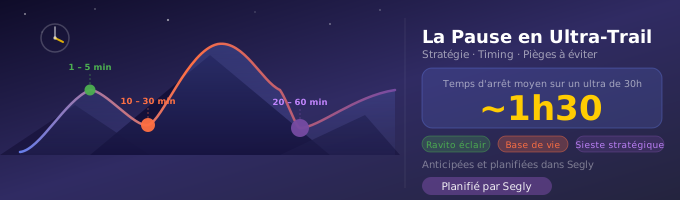
In a 30-hour ultra, you spend an average of 1 hour and 30 minutes at rest. Sometimes more. During that time, you’re not running, not cycling, and not climbing any mountain passes—and yet it often determines the final outcome. Too short, and you set off again without having recovered. Too long, and you lose your rhythm. Taking breaks during an ultra is a skill in its own right. Segly now integrates breaks directly into your race plan. Here’s everything you need to know to use them wisely.
Why Breaks Make All the Difference in a Race Plan
The fundamental problem with race plans that don’t include breaks is simple: they misrepresent split times. If you plan to arrive at a aid station at 2:00 p.m. but your plan doesn’t include a 15-minute stop, your support crew will be waiting for you at 2:15 p.m.—and you’ll set off again at 2:15 p.m. thinking you’re behind schedule. Confusion sets in, stress builds, and you set off in the wrong frame of mind.
Including breaks in your plan solves this problem at its root. Segly calculates your race pace based solely on moving time—the break isn’t factored into the calculation. But it’s fully accounted for in the total time and in all subsequent checkpoint times. Your support team knows exactly when to expect you. Your plan remains reliable from start to finish.
The 3 Types of Breaks and When to Use Them
| Type of break | Duration | Typical Use |
|---|---|---|
| Quick Refuel | 1–5 min | Energy bars, gel, head back out immediately |
| Base Camp | 10–30 min | Meal, medical care, gear change |
| Nap | 20–60 min | Ultras > 24 hours, advanced cognitive fatigue |
The quick refuel stop — 1 to 5 minutes
This is the most frequent and most underestimated stop. You stop, drink, take a gel, refill your water bottles, and head back out. In 3 minutes, nothing serious happens—except that multiplied by 8 aid stations, that adds up to 24 minutes that weren’t in your plan. A quick refueling stop is planned when the checkpoint doesn’t warrant a longer stop: no support crew, no gear changes, no hot meals. The goal is to get in and out without losing your mental rhythm.
The aid station — 10 to 30 minutes
This is the strategic stop. You sit down, eat properly, and take care of whatever needs attention. 20 minutes well spent at a support station can give you an extra 2 hours of running in your legs. This is also when the real decisions come up: change shoes? Put on a jacket? Grab the poles for the upcoming climb? The more you anticipate these decisions before the race—and the more the Segly plan helps structure them—the less time you’ll waste on the spot dithering.
The nap—20 to 60 minutes
In ultras lasting more than 24 hours, napping isn’t just an option—it’s a strategic decision. The question isn’t “Should I sleep?” but “Where, when, and for how long?”
Should you sleep? The telltale signs
Cognitive fatigue is treacherous. It’s not like physical fatigue. A runner whose legs are still working may have a brain that’s playing tricks on them—and that’s when accidents happen: mistakes reading the course markers, falls.
Signs that a nap is necessary:
- You see lights, shapes, or silhouettes that aren’t there (mild hallucinations, very common after being awake for more than 20 hours)
- You fall asleep standing up or for a few seconds while walking—micro-naps
- You can no longer figure out simple things: your estimated time of arrival, the remaining distance
- You find yourself walking without a clear purpose, mentally drifting
- You make irrational decisions (changing your route for no reason, giving up on a whim)
| Duration | Type | When to use it |
|---|---|---|
| 10–20 min | Power nap | Early signs of mental fatigue, still have energy |
| 25–30 min | Effective nap | Duration recommended by sleep science |
| 60–90 min | Full cycle | Significant lead on the schedule or major difficulty—risk of a difficult wake-up |
Should you change your shoes, socks, or clothes?
Socks: Yes, always after 12 hours
This is the most impactful—and most overlooked—change. After 12 hours of running, your socks are damp with sweat, the seams have rubbed, and pressure points are irritated. A fresh, dry pair radically improves your comfort for the rest of the race.
Simple rule:
A clean pair of socks at every major aid station. The weight in your drop bag is negligible, but the benefit is real. Take this opportunity to check your feet: developing blisters, areas of friction. A blister treated at the 80 km mark becomes an ignored blister at the 120 km mark—and a race withdrawal at the 140 km mark.
Shoes: Depending on the Conditions
Changing shoes during a race isn’t always necessary, but it can make all the difference. Two main scenarios:
Switching pairs: If you’re transitioning from dry terrain to wet and cold conditions (or vice versa), a pair suited to the conditions makes a real difference. Pack a spare pair of shoes in your drop bag if you know the conditions are going to change.
Go up a size: Your feet swell during the race—up to half a size after 20–30 hours. If you have a pair with a bit more room set aside for the halfway point, it will provide considerable comfort for the second half.
Clothing: Plan for temperature changes
Mountain ultras are often run within a temperature range of 15–20°C. A start at 22°C in the valley can drop to 4°C at the pass by 3 a.m. Changing clothes at a aid station isn’t a luxury—it’s thermal management.
What to plan for in your strategy:
- What time you’ll arrive at each aid station (Segly tells you this)
- What the temperature will be at that time at that location (Segly will also tell you that)
- What you’ll need: a mid-layer, jacket, gloves, and tights
You need to think this through before the race, not when you’re exhausted at the aid station at 2 a.m.
The Pitfalls of Taking Too-Long Breaks
A break that’s too long is sometimes worse than one that’s too short. Here’s why.
Muscle cooling
After 20–25 minutes of inactivity, muscle temperature begins to drop. Muscles contract slightly, and elasticity decreases. Setting off again after sitting for 45 minutes requires a proper warm-up—often 2–3 uncomfortable kilometers before you can regain your normal pace.
Loss of Heart Rate and Metabolic Rate
The body adjusts its metabolism to the pace of the run. A long stop resets everything—digestion resumes, and your heart rate drops. Picking up the pace again requires more effort than if you had maintained a light pace. The best ultra-trail runners know that it’s sometimes more effective to walk slowly for 10 minutes than to sit for 5 minutes.
The psychological slump
Some runners never recover from a long break. You sit down, close your eyes, let go of the pressure—and suddenly your body sends the signal that it’d rather stay right there. Motivation plummets. This is a real and well-documented phenomenon.
Lost time is gone for good
In an ultra with a time cutoff, every minute counts. A 45-minute break that was supposed to last 20 minutes means you’ve lost 25 minutes you’ll never get back. Multiply that by 3 or 4 stops at aid stations, and it can mean the difference between finishing and not finishing (DNF).
Break Strategy for Ultras Over 6 Hours
Plan your breaks BEFORE the race
The best decision about a break is made when you’re not exhausted. Before the start, while preparing your Segly plan, you can decide: at the aid station at km 45, 5 minutes; at the aid station at km 80, 20 minutes; at the aid station at km 140, 30 minutes, including a change of socks and jacket. These decisions, made with a clear head, are infinitely better than those made on the course while you’re tired and under pressure.
The Energy-Time Equation
The question to ask yourself before every break: Is the benefit (recovered energy, comfort, mental state) worth the time it costs me? For a runner who still has energy and is thinking clearly, a long break offers almost no benefit. For a runner nearing the end of the race with blisters, heavy legs, and low morale, 20 minutes of care and food can be the most worthwhile investment of the race.
The Preventive Break vs. the Curative Break
The best runners don’t just stop when things go wrong—they stop to prevent things from ever spiraling out of control. Planning a nap at 3 a.m. before you actually need it means avoiding that 5 a.m. moment when sleep deprivation becomes unmanageable.
The data confirms it: runners who manage their mid-race breaks well finish stronger than those who push themselves to the limit and then have to stop in a pinch. Stopping while you’re still feeling good seems counterintuitive. Yet that’s the approach of those who make it to the finish line.
Communicate the plan to your support crew
A well-planned break is useless if your support team doesn’t know what to do during that time. Brief them before the race: At the 80 km mark, I’ll stay for 20 minutes—hot soup, spare socks in the red bag—and don’t let me sit for more than 20 minutes, even if I resist. Segly generates a shareable link that your support team can view in real time, with estimated split times that include all your breaks.
In summary
Breaks during an ultra aren’t a sign of weakness—they’re part of your race strategy. When well-planned, they allow you to run longer, harder, and finish in a state that still feels like fun. When mismanaged, they can cost you a time cut, disrupt a painstakingly built pace, or leave a runner unable to continue, sitting on a chair at 3 a.m. The difference between the two comes down to preparation. Segly now incorporates breaks into your plan so you can anticipate them, time them properly, and communicate them to your support team—even before you lace up your running shoes.