 SEGLY
SEGLY
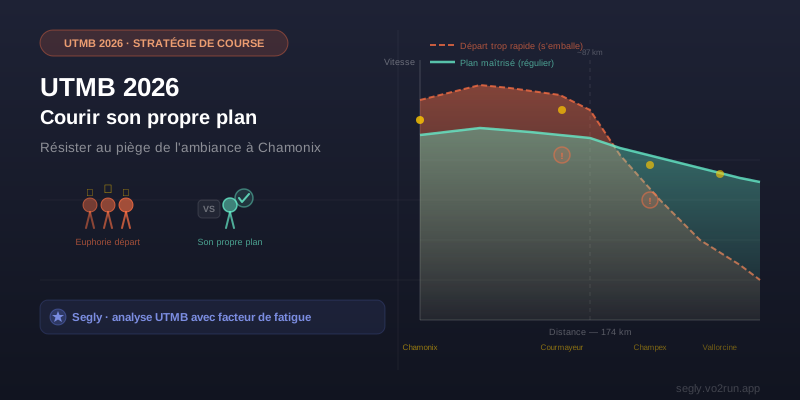
The UTMB is probably the race where runners sabotage themselves the most. Not because of the terrain, not because of the weather, not because of poor training. Because of the atmosphere. Because of that dense crowd on the Boulevard du Mont-Blanc, those thousands of spectators in Chamonix, that music, those tears at the start. I’ve seen perfectly prepared runners throw their race plan out the window within the first 5 kilometers because they couldn’t resist the collective momentum. This article is for you if you have a plan—and if you still want to stick to it by the time you reach Courmayeur.
The Euphoria of the Start: Trap Number 1 in Chamonix
The start of the UTMB Mont-Blanc is an emotional experience that’s hard to prepare for rationally. The Place du Triangle de l’Amitié, the pulsing sound system, the announcements in multiple languages, the race bibs on 2,500 runners—all of this creates a kind of atmospheric pressure on your brain that tells it: Go for it, this is the moment, give it your all. And your brain obeys. It releases adrenaline, it dulls your perception of fatigue, and it makes you set off at a pace you won’t be able to sustain for 174 km.
The physical issue is simple: the first few kilometers of the Chamonix Ultra-Trail are fast-paced and mostly downhill all the way to Les Houches. With the adrenaline of the start and the pressure from the runners around you, it’s extremely easy to start 15 to 20% too fast on these initial segments. In absolute terms, that might save you 5 to 8 minutes. But in real time at the 90 km mark in Courmayeur, those 5 minutes might have cost you 2 hours of dealing with muscle fatigue.
The rolling sections at the start: how not to get carried away
Chamonix — Les Houches — Saint-Gervais: the first few kilometers of the 2026 UTMB are the most deceptive part of the race. The terrain is rolling, the Friday night atmosphere is electric, there are plenty of spectators, and the effort seems minimal. This is exactly where your race plan is put to the test. Not at Grand Col Ferret. Not at La Fouly. On the first rolling sections at night around Chamonix.
The only thing that protects your race plan at this stage is having objective data on hand: a target split time for Les Houches, a maximum heart rate you won’t exceed, or a perceived exertion level you monitor regardless of the pace of the runners around you. If you’re thinking, “I’m fine—I’m not in the red zone,” on the first rolling sections of the UTMB, it’s often already too late. The red zone in an ultra doesn’t show up immediately—you’ll pay the price 6 to 8 hours later.
The Mid-Race Warning Signs: What to Watch For
There are three checkpoints on the UTMB where runners who mismanaged their start reveal themselves. These are natural indicators of how your race is really going.
| Refreshment Station / Key Point | Warning Sign | What to Do |
|---|---|---|
| Courmayeur (~80 km) | Heavy legs, painful descent before the finish | Eat a hot meal, sit for 10 minutes, don’t push yourself to resume riding |
| Champex-Lac (~120 km) | Strong urge to stop, nausea, low morale | Caffeine, salty food, set the next checkpoint as your immediate goal |
| Vallorcine (~150 km) | Unable to pick up the pace, walking involuntarily | Manage the final stretch, don’t push too hard—protect your tendons over the remaining 24 km |
If you arrive in Courmayeur with light legs and the urge to pick up the pace, you’ve managed your start well. If you arrive with already burning quads and the urge to lie down, the signal is clear: you’ve paid the price for the euphoria of the start. The solution in both cases is to manage the rest of the race segment by segment, aid station by aid station, without ever thinking about the finish line before Vallorcine.
Sticking to Your Own Plan Over 174 km
Managing a 174-km ultra-trail race is based on a simple principle that’s hard to apply under pressure: run your own plan, not someone else’s. That means having target split times before the start—not vague estimates, but precise numbers for each aid station—and sticking to them even when the atmosphere pushes you to go faster, even when you feel good, even when you see runners at your level pulling ahead.
The fatigue factor is the most concrete tool for bringing this plan to life. If you’re aiming for a 10% fatigue factor—which represents excellent pacing on the UTMB—that means your pace in the second half of the race shouldn’t drop by more than 10% compared to your pace in the first half. It’s a simple mathematical constraint with concrete implications: every kilometer run too fast in the first half is a wasted investment for the rest of the race. Serious UTMB preparation involves modeling this factor before the start and structuring your split times accordingly.
Between aid stations, the only mental breakdown that works over 174 km is the next aid station. Not the finish line, not Courmayeur if you haven’t reached it yet—the next checkpoint. The 174 km of the Tour du Mont-Blanc Trail become a series of small goals, each achievable, each enough to maintain the mental momentum needed to finish on your feet.
Weather and Managing Conditions Around Mont Blanc
The Tour du Mont-Blanc Trail crosses three countries and several mountain ranges over 174 km, which means radically different weather conditions depending on your location along the course. The French-Italian ridges can be swept by strong winds while Chamonix is basking in the sun. The Swiss sections around Champex-Lac may be under a squall while Courmayeur remains dry. It’s impossible to anticipate these variations 100%—but you can prepare for them.
The temperature range around Mont Blanc over a 30- to 45-hour race can easily reach 25°C between the nighttime low at high altitude and the afternoon heat in the Aosta Valley. Pack your bag with adjustable layers, put on your jacket before the passes (not after), and plan your gear segment by segment based on your estimated time of passage and altitude—not on the general weather forecast for the entire route.
Conclusion
The 2026 UTMB is decided within the first 20 kilometers. Not in terms of performance—but in terms of discipline. The ability to resist the euphoria of the start in Chamonix, to let runners pull ahead without chasing them on the fast-paced early sections, and to stick to your target times despite the pressure of the atmosphere: that’s the real UTMB strategy. Everything else—nutrition, weather, and nighttime management—revolves around this first phase.
Segly offers a pre-calculated analysis for each UTMB format—customizable based on your ITRA level and with an adjustable fatigue factor to specifically avoid the trap of starting too fast. Prepare for your 2026 UTMB with Segly →