 SEGLY
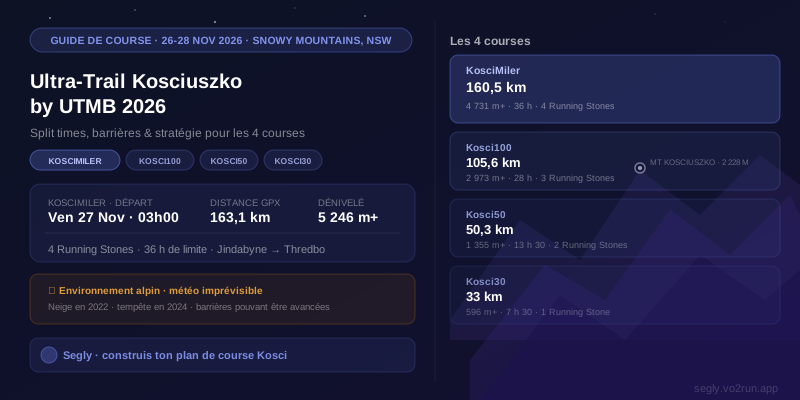
In the last week of November, the Snowy Mountains of New South Wales host the Ultra-Trail Kosciuszko by UTMB, Oceania's alpine ultra-trail and one of the most iconic UTMB World Series events in the Southern Hemisphere. From 26 to 28 November 2026, runners will cross snow gum forests, granite outcrops, alpine meadows and snowmelt-fed streams. The two longest races lead to the summit of Mount Kosciuszko, the highest point on the Australian mainland (2,228 m). All four races finish in the alpine village of Thredbo.
All four distances are full. If you're on the start list, this guide gives you everything you need for these final days of preparation: the key numbers for each race, the cutoffs that matter, what the mountains can throw at you, and how to build a pacing and nutrition plan you can actually execute on race day.
Ultra-Trail Kosciuszko by UTMB 2026 — KosciMiler 161K, Kosci100, Kosci50, Kosci30
The 4 races at a glance
| Race | Date & start | Start → Finish | Distance | D+ | Cutoff | Stones |
|---|---|---|---|---|---|---|
| KosciMiler | Fri 27 Nov, 03:00 | Jindabyne → Thredbo | 160.5 km | 4,731 m+ | 36 h | 4 |
| Kosci100 | Fri 27 Nov, 07:30 | Perisher → Thredbo | 105.6 km | 2,973 m+ | 28 h | 3 |
| Kosci50 | Thu 26 Nov, 07:00 | Perisher → Thredbo | 50.3 km | 1,355 m+ | 13 h 30 | 2 |
| Kosci30 | Thu 26 Nov, 10:00 | Perisher → Thredbo | 33 km | 596 m+ | 7 h 30 | 1 |
Data sourced from official race pages. Always check the official Runner Guide before race day.
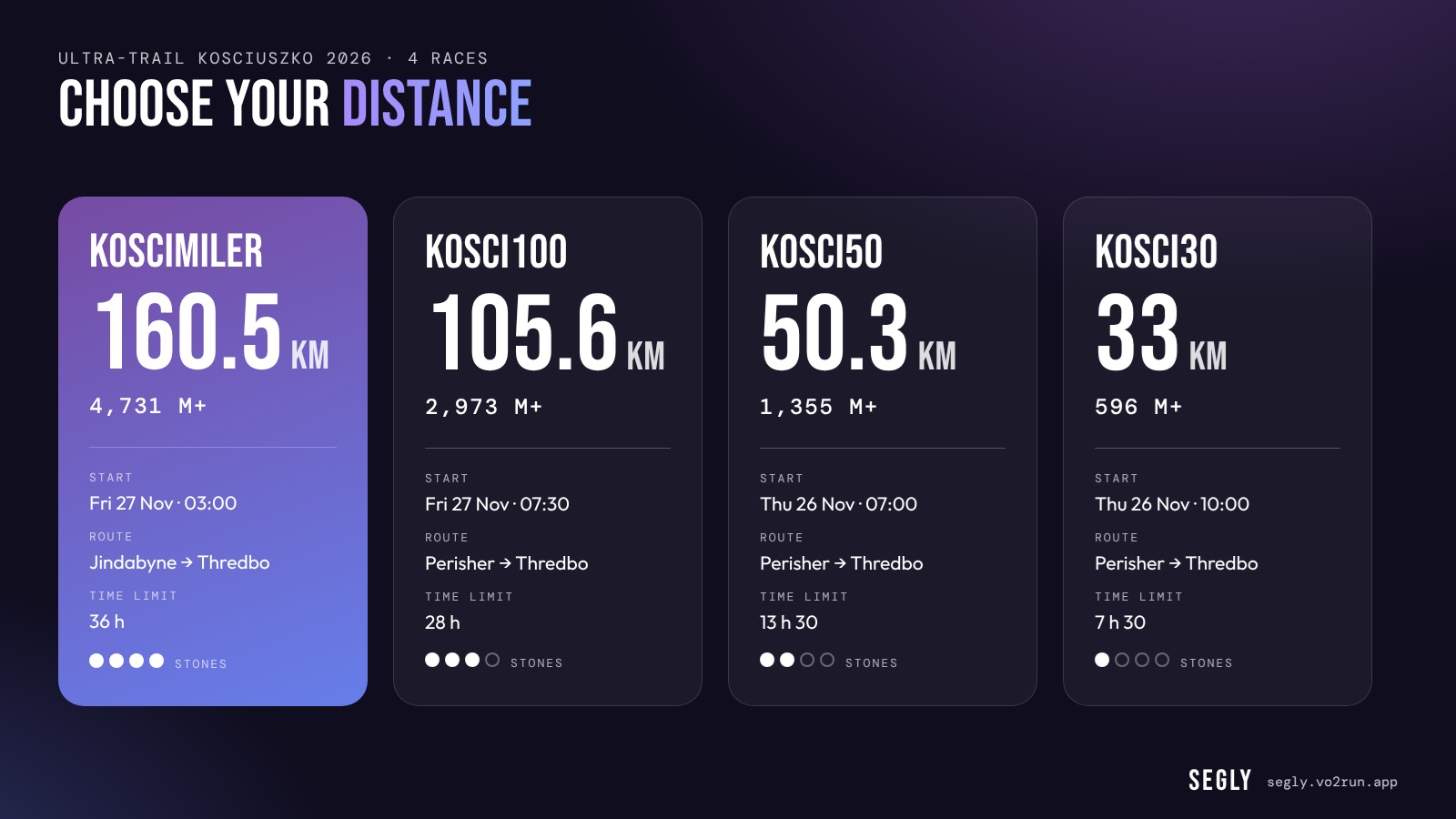
The 4 distances of the Ultra-Trail Kosciuszko by UTMB 2026
KosciMiler (161 km): crossing the Snowy Mountains
The KosciMiler is the flagship race of the event and a UTMB World Series 100M. It starts at 3:00 am on Friday 27 November from Banjo Paterson Park in Jindabyne. The course follows Lake Jindabyne and the Thredbo Valley Trail, then climbs onto the alpine plateau via Perisher and Charlotte Pass to the summit of Mount Kosciuszko. It then continues towards Guthega and Smiggin Holes, drops back into the Thredbo valley, and finishes with a loop through the ski resort before reaching Friday Flat.
Two elements are easy to underestimate:
- The night. You start in the dark, and most of the field will run through the entire Friday night. Plan your headlamp, spare batteries and warm layers for two separate overnight sections, not just one.
- The real distance. The official listing shows 160.5 km and 4,731 m+, but the 2026 time chart is built from a GPX that measures 163.1 km and approximately 5,246 m+. On a 100-miler, an extra 2.6 km and 500 m of elevation can add an hour or more. Plan with the actual GPX, not the advertised figures.
KosciMiler checkpoints and cutoff times
| Checkpoint | Km | Cutoff | Crew | Drop bag |
|---|---|---|---|---|
| CP1 Gaden Trout Hatchery | 12.6 | Fri 05:25 | No | No |
| CP2 Bullocks Flat (out) | 32.0 | Fri 09:35 | Yes | Yes |
| CP3 Charlotte Pass Resort | 57.0 | Fri 15:05 | Shuttle only | Yes |
| Mt Kosciuszko Summit | 68.3 | None | No | No |
| CP4 Charlotte Pass Lookout | 81.1 | Fri 20:05 | Shuttle only | No |
| CP5 Guthega Base Camp | 90.9 | Fri 22:05 | Yes | No |
| CP6 Guthega Power Station (out) | 99.4 | Fri 23:50 | Yes | Yes |
| CP7 Guthega Power Station (in) | 109.0 | Sat 02:10 | Yes | Yes |
| CP8 Perisher Ski Tube | 119.1 | Sat 04:20 | Yes | Yes |
| CP9 Bullocks Flat (in) | 132.2 | Sat 06:50 | Yes | Yes |
| CP10 Ngarigo Campground | 140.3 | Sat 08:40 | No | No |
| CP11 Keller Plaza, Thredbo | 151.4 | Sat 11:15 | Yes | Yes |
| Finish — Friday Flat | 163.1 | Sat 15:10 | Yes | Yes |
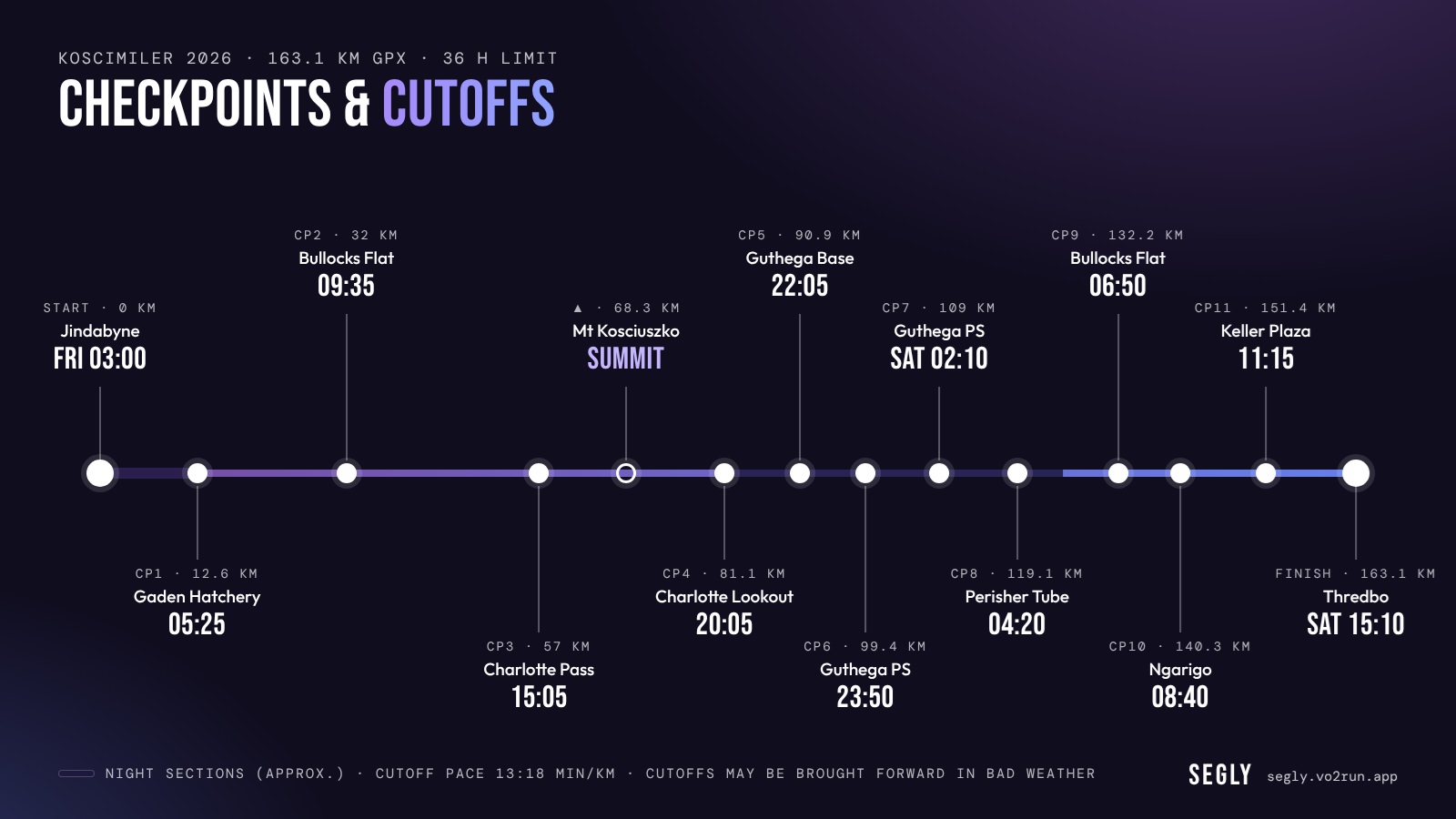
KosciMiler 2026 checkpoint timeline and cutoffs — Jindabyne (Fri 03:00) to Thredbo (Sat 15:10)
The overall cutoff pace is 13:18 min/km, which sounds generous until you factor in climbs, aid station stops, a cold night and tired legs. Pacers are allowed from CP6 Guthega Power Station (99.4 km). Race management may tighten cutoffs in the event of bad weather.
Kosci100 (106 km): to the top of Australia
The Kosci100 is a UTMB World Series 100K. It starts at 7:30 am on Friday 27 November from Perisher Ski Resort and covers 105.6 km with 2,973 m+. After a short loop around Perisher, the course follows the Snowies Alpine Walk along a ridge overlooking the Thredbo valley to Charlotte Pass. It then climbs Mount Kosciuszko and continues along the Main Range Walking Track to Guthega. Runners return via Smiggin Holes to Perisher, drop down to Bullocks, climb back up the valley to Thredbo and finish with a loop through the ski resort.
The time limit is 28 hours (final cutoff at 12:00 Saturday). The Main Range is the most exposed section of the course: high, open and incredibly scenic, but completely unshielded if the weather turns. Time pressure builds mostly in the first half — don't let the alpine views pull you into going out too fast.
Kosci50 (50 km): the ultra for marathon runners
The organisers pitch the Kosci50 as the ideal step up from the marathon. It starts at 7:00 am on Thursday 26 November from Perisher Ski Resort and covers 50.3 km with 1,355 m+. The course begins on the alpine plateau, drops down to Bullocks Flat, then climbs the Thredbo valley to the Eagles Nest high point before descending to the finish at Friday Flat.
The time limit is 13 hours 30, roughly 16 min/km. The real challenge lies in the profile: a long descent early on, then the climb to Eagles Nest when your quads are already loaded. Save something for that climb — the final descent rewards runners who still have fresh legs.
Kosci30 (33 km): the accessible race
The Kosci30 starts at 10:00 am on Thursday 26 November from Perisher Ski Resort and covers 33 km with 596 m+. It is an entry-level race on smooth, well-travelled single track. The course passes through alpine viewpoints, drops to Bullocks Flat, then follows the flowing trails of the Thredbo valley to the finish.
The cutoff is 7 hours 30. Because it is so well-travelled, the Kosci30 lends itself to going out too hard. A steady pace you can hold through the gentle valley climb will serve you far better than blasting the first 10 km.
Weather, gear and the alpine environment
The Snowy Mountains are a true alpine environment, and late-November weather is unpredictable. The KosciMiler has already been disrupted twice:
- 2022: the course was modified due to snow.
- 2024: the race ran through a storm.
For all four distances, take the mandatory gear list seriously and prepare for the worst, not the forecast. On the high plateau around Charlotte Pass, Kosciuszko and the Main Range, temperatures can drop rapidly, wind exposure is significant, and slow hiking in wet layers can become dangerous. For the Miler and the 100, plan precisely where you will add or remove layers, and when your headlamp needs to come out.
Pacing strategy: building your race plan
A strong finish at Kosciuszko depends far more on pacing and nutrition than on fitness gained in the last 10 days. Here is how to use the time you have left.
1. Start from the actual GPX
Download the official 2026 GPX and use it, not the advertised distance. Break the course into segments between checkpoints and analyse each one separately: distance, ascent, descent and terrain type.
2. Plan by segment, not average pace
A smoothed average pace means nothing on a mountain course. The Thredbo Valley Trail is fast and runnable, the climbs onto the plateau are power-hiking terrain, and technical descents cost time even when you feel good. Give each segment its own target pace based on gradient and terrain.
3. Decide in advance where you will walk
On a 100-miler, almost everyone walks a large portion of the course. Runners who do well decide where they will walk ahead of time. A useful rule: when your pace drops below roughly 5.5 km/h, power hiking is generally more efficient than running.
4. Build your plan around the cutoffs
For mid- and back-of-pack runners, the most important number is not your finish time but your buffer at each cutoff. Write your projected arrival time at each checkpoint next to the cutoff. If your buffer drops below an hour at any point, rethink your plan before race day.
5. Plan nutrition and hydration by segment
Over 16 to 36 hours of effort, fuelling determines how your race ends. Calculate how many carbohydrates, how much fluid and when you will take caffeine on each segment, based on how long you expect that segment to take. The long gaps between aid stations — such as the stretch between Charlotte Pass and the summit — are where runners eat least and pay for it later.
6. Give your crew a schedule
On the Miler, your crew can meet you at CP2, CP5 through CP9 and CP11 (shuttle access only at Charlotte Pass). A schedule with your projected arrival times, what you will need at each stop, and when you will swap headlamps or layers makes every stop faster and calmer.
Recent KosciMiler results
The course changes every year, so there is no official course record. Recent winning times are still a useful reference point:
| Year | Men | Women | Notes |
|---|---|---|---|
| 2025 | Morgan Glazier (GBR), 17:38:25 | Stephanie Auston (AUS), 19:45:57 | 223 finishers |
| 2024 | Sam Harvey (NZL), 16:38:59 | Sabrina Stanley (USA), 19:33:58 | Storm, hold |
| 2023 | Chris Lenkic (AUS), 19:23:07 | Manuela Soccol (BEL), 22:24:48 | Course 164.6 km |
| 2022 | Adrian MacDonald (USA), 14:07:42 | Sarah Ludowici (AUS), 19:23:01 | Modified course — snow |
When results come in on 28 November, it will be worth looking at how the leaders managed their effort between the first and second half. On mountain 100-milers, the runners who slow down the least in the back half are generally on the podium.
Build your Kosci plan with Segly
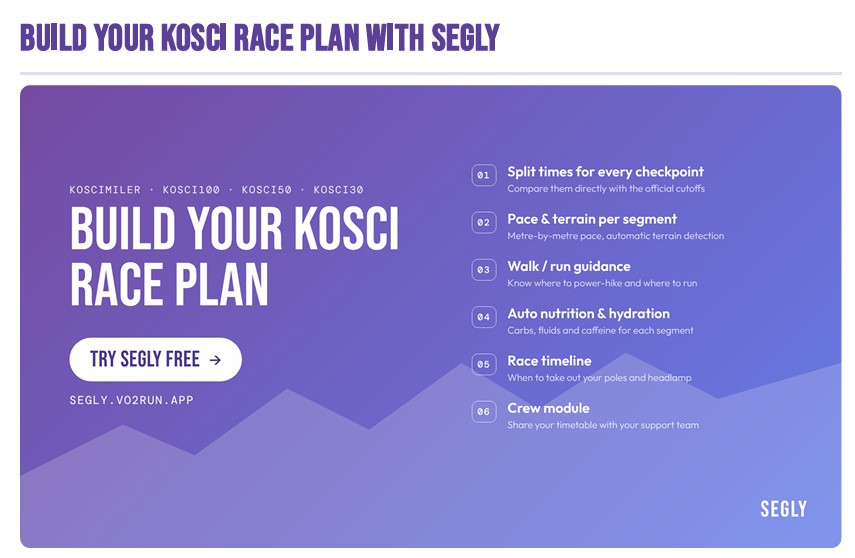
Segly is a GPX analysis and race strategy app built by trail runners for exactly this kind of event. Import the Ultra-Trail Kosciuszko GPX for your distance, enter your level, and Segly builds a complete race plan:
- Projected times at every checkpoint, directly comparable against the official cutoffs.
- Segment-by-segment paces, with metre-by-metre detail on the elevation profile.
- Automatic terrain detection (from very runnable to technical) to adjust your pace where the trail gets tough.
- Walk/run recommendations for every segment — knowing where to power hike and where to run.
- Intensity zones by segment, to manage your effort over 16 to 36 hours.
- Automatic nutrition, hydration and caffeine by segment, based on your runner profile.
- Race timeline showing when to pull out your poles and your headlamp.
- Crew module to share your schedule and needs with your support team.
Founder Clément Thuaudet used his own Segly plan at Euskal Trail 130 and finished 18th in 20h57. He found the race less stressful, slept better the night before, and managed his pacing and nutrition more consistently than in his previous ultras.
There are 10 days until the start. It is too late to gain fitness, but it is enough time to build a clear plan. Try Segly for free and create your KosciMiler, Kosci100, Kosci50 or Kosci30 race plan today.
FAQ — Ultra-Trail Kosciuszko 2026
When does the Ultra-Trail Kosciuszko 2026 take place? Thursday 26 to Saturday 28 November 2026. The Kosci30 and Kosci50 are run on Thursday 26 November, and the Kosci100 and KosciMiler start on Friday 27 November.
Can I still register? No. All four races are full for 2026.
Where do the races start and finish? The KosciMiler starts in Jindabyne. The Kosci100, Kosci50 and Kosci30 start at Perisher Ski Resort. All four races finish in Thredbo.
How hard is the KosciMiler? It is a full mountain 100-miler: approximately 161 km with at least 4,700 m of elevation gain (around 5,200 m on the 2026 GPX), a 3:00 am start, an entire night on course and a 36-hour cutoff. The course is runnable but alpine weather is a real risk.
How many Running Stones does each race earn? KosciMiler 4, Kosci100 3, Kosci50 2, Kosci30 1.
Are pacers allowed? Yes, from CP6 Guthega Power Station (99.4 km) for the KosciMiler.
How do I build a race plan for Kosciuszko? Download the official GPX for your distance on Segly, enter your level and goals, and the app automatically generates your checkpoint times, segment paces, nutrition plan and more.