 SEGLY
You've just crossed the finish line of a trail race. A few days later, you get an email from BeTrail with your score. On Strava, someone comments on your result mentioning your "ITRA rating". And when you aim for the UTMB, people talk about the UTMB Index. Three systems, three numbers — and a fair question: what's the difference, and which one should you use to prepare your next race?
Why so many ranking systems in trail running?
Trail running has a fundamental problem: comparing two performances on different races is almost impossible by eye. A 50 km mountain race with 3,500 m of D+ has nothing in common with a 50 km forest race on rolling paths. Yet both are "50 km trail".
Several algorithms were developed independently to solve this, each with its own mathematical approach to normalise performances and make them comparable. The result: three main systems coexist in the French-speaking trail world today.
The ITRA score: the global reference
What is it?
The ITRA (International Trail Running Association) is the international body that governs trail running. Its performance index — the ITRA Performance Index — is a score from 0 to 1000 that measures your level in trail running based on your results in ITRA-certified races.
How is it calculated?
For each ITRA-labelled race, an individual score is assigned to you. This score compares your finishing time with the best theoretical performance possible on that course, taking into account distance, positive and negative elevation, and average altitude. An important feature: the algorithm also factors in the actual race conditions. If the weather was terrible on race day, all runners benefit in their score — which allows performances from different editions to be compared.
Your overall performance index is then calculated as the weighted average of your 5 best results over the last 36 months. The more recent a result, the more it weighs in the calculation. A result older than 12 months starts to gradually lose value in the formula.
Benchmarks to know
| ITRA score | Level |
|---|---|
| < 300 | Beginner to intermediate |
| 300 – 450 | Good runner, regional trails |
| 450 – 600 | Experienced, demanding trails |
| 600 – 700 | Expert — historical UTMB eligibility threshold |
| 700 – 850 | Very high level, semi-elite |
| > 850 | World elite |
Who is it for?
For all trail runners who race ITRA-certified events, whatever the distance or level. It's the most universal and most representative system on a global scale.
The UTMB Index: the tool of the UTMB World Series circuit
What is it?
Since 2021, the UTMB Group has developed its own evaluation system for its global race circuit. The UTMB Index is a score from 0 to 1000, calculated only from results obtained in UTMB World Series-approved races.
Be careful not to confuse the UTMB Index with the Running Stones — these are two distinct and complementary things. Running Stones are used to access the lottery for the finals; the UTMB Index attests to your level for finishing the target race. To enter the Chamonix finals, you need both.
How is it calculated?
As with the ITRA, the UTMB Index is based on the weighted average of your 5 best results over the last 36 months in eligible races. Its specificity: it is categorised by distance — 20K, 50K, 100K and 100M — which makes it possible to assess your level specifically on the format you're interested in.
A UTMB Index is considered valid only if you have finished at least one approved race in the last 24 months. Without a recent race, your index expires.
The main limitation
The UTMB Index only takes into account races on the UTMB World Series circuit. If you mainly run French trails outside the UTMB circuit — the Templiers, the SaintéLyon, the Grand Raid du Finistère — you don't build up data for your index. This can make it less representative of your real level if you're not a UTMB circuit runner.
The BeTrail level: the French-speaking specialist
What is it?
BeTrail is a platform created in 2015 by two Belgian trail enthusiasts, Mathieu and Matthieu. It now gathers more than 12 million trail results from France, Belgium, Luxembourg, the Netherlands and beyond. Its algorithm assigns each runner a BeTrail level, generally between 20 and 110 — the higher the number, the better the performance.
How is it calculated?
BeTrail calculates a normalised performance index for each result, which makes it possible to compare performances from very different races. The BeTrail level is then the weighted average of your 3 most representative recent performances. The more recent a performance is, and the higher it is relative to all runners on that course, the more it weighs in the calculation.
BeTrail's great strength: its volunteers enter the results of French-speaking trails every week, even small regional races. You don't have to do anything — if you finished a race present in their database, your result is there.
The main limitation
BeTrail is very strong on French-speaking races but is less representative on a global scale. If you mainly run international trails outside the French-speaking area, coverage will be less complete.
Quick comparison of the three systems
| ITRA | UTMB Index | BeTrail | |
|---|---|---|---|
| Scale | 0 – 1000 | 0 – 1000 | 20 – 110 (higher = better) |
| Created by | ITRA (international) | UTMB Group | Two Belgian enthusiasts |
| Races included | All ITRA-certified races | UTMB World Series races only | Mainly French-speaking trails |
| Number of results | 5 best / 36 months | 5 best / 36 months | 3 best recent |
| Validity | 36 months | 24 months minimum | Active if result < 2 years old |
| Categories by distance | Yes | Yes (20K / 50K / 100K / 100M) | No |
| Updated | After each certified race | After each eligible race | Every week by volunteers |
| Main use | Universal global reference | UTMB circuit qualification | Francophone tracking and comparison |
ITRA vs UTMB Index: are they comparable?
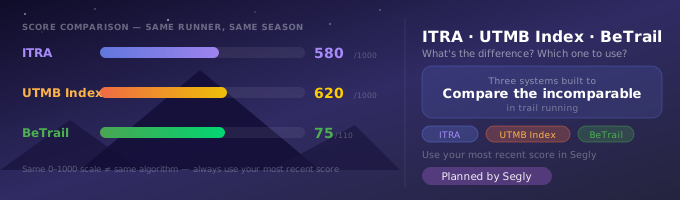
Technically, both score on a 0 to 1000 scale, but their calculation methods are independent. On the same race, you can get an ITRA score of 580 and a UTMB Index of 620 — that's not an anomaly, the algorithms simply aren't identical.
The UTMB Index was created in 2021 when the UTMB Group decided to stop using the ITRA score for its qualifications. The two systems now evolve separately.
Which one should you use to prepare your race with Segly?
Segly uses your level score to calculate your split times segment by segment and adapt the estimated pace to your reality as a runner. Here's our recommendation:
Use the most recent data available. A score that is 3 years old is less representative of your current level than a 6-month-old one, even if the first comes from a "more prestigious" system.
The priority order used in Segly is as follows:
- ITRA score — the most universal and best calibrated on the technicality of courses
- UTMB Index — very reliable if you mainly run on the UTMB circuit
- BeTrail level — excellent if you run French-speaking trails and your ITRA score is missing or old
- VMA — useful when you don't yet have official trail results, or for runners coming from road running
If you have a recent ITRA score, use it. If your last ITRA-certified trail is more than 18 months old but you've since run several UTMB World Series trails, your UTMB Index will be more representative. And if you mainly run non-certified regional French trails, your BeTrail level will probably be the most accurate data.
In summary
All three systems try to solve the same problem — comparing the incomparable in trail running — but from different angles. The ITRA is the most universal global reference. The UTMB Index is essential for the UTMB circuit but limited outside it. BeTrail is the best tool for French-speaking trails and day-to-day progress tracking.
For Segly, what matters is not the system but the freshness of the data. A recent score from any of the three systems will give a much more precise race plan than a perfect score that is two years old.
Want to test your race plan with your ITRA, UTMB Index or BeTrail score? Import your GPX on segly.vo2run.app and generate your split times segment by segment in 2 minutes. Over to you!