 SEGLY
SEGLY
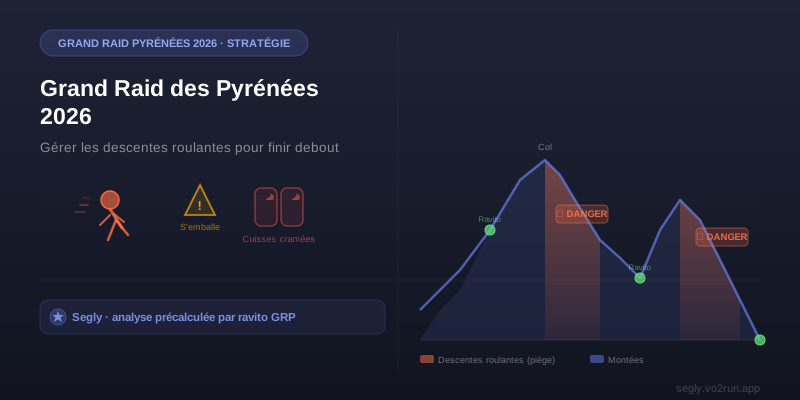
In the GRP, the mistake that wrecks your legs doesn’t happen on the climbs. It happens on the first descents—those long, rolling Pyrenean descents where everyone gets carried away, where you race downhill at full speed because it feels effortless, because your thighs aren’t hurting yet, because it’s all too easy to let go. Eighty percent of runners who drop out or finish well below their goal make exactly this mistake: they burn through their energy on the descents instead of saving it for later. This article is here to help you avoid that trap.
The GRP’s topography: rolling descents that take a toll on your legs
The Grand Raid des Pyrénées is a race unlike any other on the ultra calendar. While the UTMB features steep mountain passes and technical climbs, the GRP offers long, rolling, and sometimes seemingly endless descents along several kilometers of Pyrenean singletrack. It’s tempting. It’s even exhilarating in the first few hours. But it’s also a total trap.
In both the 120-km and 160-km races, these rolling descents often come early in the race—when your legs are fresh, fueled by the adrenaline of the start, and, above all, with the impression that they require no effort. The classic mistake in the GRP is exactly that: confusing a descent that’s easy to run with a descent that costs nothing. The eccentric contraction of the quadriceps over 3, 4, or 5 kilometers of sustained descent really takes its toll. And over 120 or 160 kilometers, you’ll always end up paying the price.
How to Manage Downhills Without Burning Out
The GRP’s golden rule is counterintuitive for any runner coming from short-distance trail running: resist the urge to race downhill. It’s not that the descent is dangerous—it isn’t always. It’s that racing down the first few rolling descents too fast burns out your thighs for the rest of the race. And the Pyrenean climbs that come next are merciless on already exhausted quadriceps.
What does this mean in practice? It means running downhill at a reasonable perceived effort rather than at your top speed. It means letting the runners around you pull ahead without chasing them when the pace picks up. It means keeping your poles active on descents to take the strain off your thighs, even when the terrain doesn’t require it. It means treating every rolling descent on the GRP as an investment in what’s to come—not as a recovery period or a chance to gain time.
Preparing Your Race Plan Segment by Segment
In the GRP, a generic race plan—“I’m aiming for X hours, so an average of Y min/km”—never holds up. The Pyrenean terrain dictates its own rules: technical climbs where you’ll have to walk, windy ridges where your pace drops, and rolling descents where your time can vary by a factor of two depending on how you handle them. The only plan that works is a segment-by-segment plan, aligned with the official aid stations.
This means knowing before the start which sections you can run (false flats, forest singletrack, gentle descents), the sections where you’ll be walking briskly (climbs steeper than 15–20%), and the sections where the weather can change everything (exposed ridges, high-altitude stretches). On the Pyrenees Trail, temperature differences between a climb through the forest and a ridge at 2,000 meters can reach 20°C. Anticipating these transitions also means anticipating your energy expenditure and nutritional needs.
| Type of Segment | Main Challenge | Guidance |
|---|---|---|
| Long, rolling descent | Getting carried away, overworking your quadriceps | Moderate effort, active poles |
| Ascent > 20% | Pushing too hard, climbing too fast | Brisk walking, steady pace |
| Windy, exposed ridge | Underestimating the energy cost | Put on your jacket before the pass, eat |
| Nighttime section in the valley | Slowing down without realizing it | Caffeine, hot food at the aid station |
Nutrition and hydration tailored to conditions
On the Pyrenees Ultra-Trail, nutrition must adapt to the actual conditions of each segment. In hot weather in the valley—and the GRP can feature very hot valleys in summer—water and sodium needs skyrocket. A 15-km dry segment at 28°C with a hot breeze can easily result in 600 to 800 mL of water consumed and just as much lost through evaporation. Underestimating these losses means arriving at the next aid station with heavy legs for reasons that go beyond just muscle fatigue.
The most effective strategy on the GRP: eat consistently at every aid station, without waiting until you’re hungry. The feeling of hunger often disappears after 6–8 hours of exertion, especially in intense heat. Set an alarm every 30 to 40 minutes to remind yourself to eat between aid stations. And on rolling descents—those infamous deceptive sections—take the opportunity to eat a gel or a bar: this is when digestion is easiest, before the climbs that restrict blood flow to the intestines.
Nighttime in the Pyrenees: What Changes
The nighttime GRP is a different race. The temperature drops, often by 15°C or more compared to the hottest hours of the day. Your metabolism naturally slows down between 1 a.m. and 4 a.m. And above all, the fatigue that has built up since the start radically changes the way you experience each segment.
Managing the night on the Cauterets Trail—or any other GRP format—is, above all, about managing one segment at a time. Don’t think about the finish line. Think about the next aid station. What time you’ll arrive there. What gear you need to pull out—a warm layer, a second pair of gloves, a buff. What hot food will do you good. The night in the Pyrenees can be harsh: fog in the mountain passes, wind on the ridges, a trail that disappears in the beam of your headlamp. Every kilometer marked you pass is a victory. Add up the kilometers marked; don’t worry about the kilometers remaining.
Weather and segment-by-segment preparation: when training for a Pyrenean mountain trail run, the temperature difference can reach 20°C between the valley and the mountain passes. Prepare your gear segment by segment—not for the entire race. Putting on a windbreaker before reaching the pass saves you 10 minutes of exposure to the cold and just as much energy spent trying to warm up.
Conclusion
The 2026 Grand Raid des Pyrénées is won or lost in the first few hours of the race, on those rolling descents that everyone takes too fast. The race strategy that works over 120 km or 160 km is patience: resist the urge to rush downhill, stick to your own plan, and manage the race segment by segment rather than focusing on an average pace—which means nothing on this terrain.
Segly offers a pre-calculated analysis for each GRP distance—breakdown by official aid stations, estimated split times, and an adjustable fatigue factor. Prepare for your 2026 GRP with Segly →