 SEGLY
SEGLY
20 hours and 57 minutes. That’s how long it took me to complete the Euskal Trail 130—128 km with 7,500 m of elevation gain in the mountains of the Basque Country. And what struck me most at the finish line wasn’t the exhaustion, nor the pride of finishing in the top 20 overall. It was this number: a −2-minute deviation from the Segly plan.
Before the start, I’d built a complete strategy on Segly—15 manually divided segments, fatigue factor set at 15%, Plan A finish time set at 9:00 p.m. The app had predicted 8:59 p.m. I crossed the finish line at 8:57 p.m.
Over 21 hours of effort, 7,500 meters of elevation gain, 17 official checkpoints—a two-minute difference. That’s not luck. That’s what real preparation based on GPX analysis makes possible. But beyond the final result, the race told me something far more interesting: the story of a first half marked by a steady lead, a second half that chipped away at that lead, and a finish line crossed exactly as planned. In this article, I break down the 17 checkpoints one by one, the three phases of the race, and what the data reveals about my actual fatigue factor.
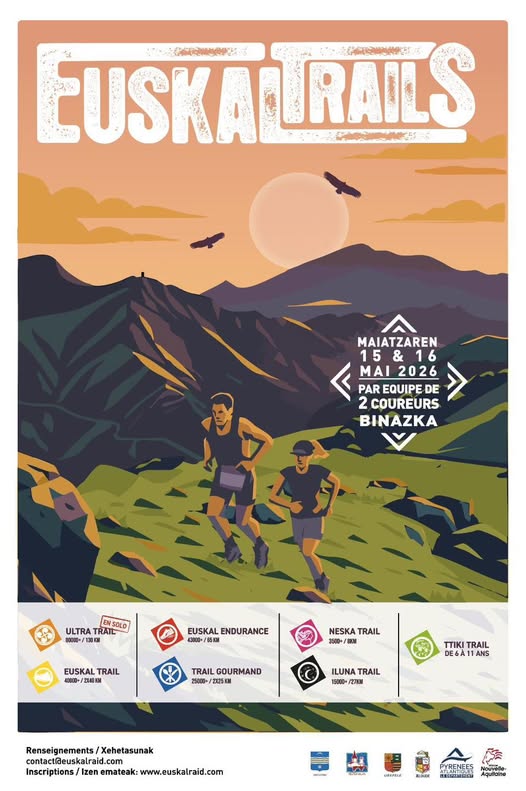
The Euskal Trail 130: A Race of Character
The Euskal Trail is no joke. The race winds through the Basque Country—challenging mountain passes, ridges exposed to the wind, and technical descents that take a toll on your quads. Spanning 128 km and 7,500 m of elevation gain between France and Spain, the course never really lets up: the climbs come one after another without respite, and the descents demand concentration and caution.
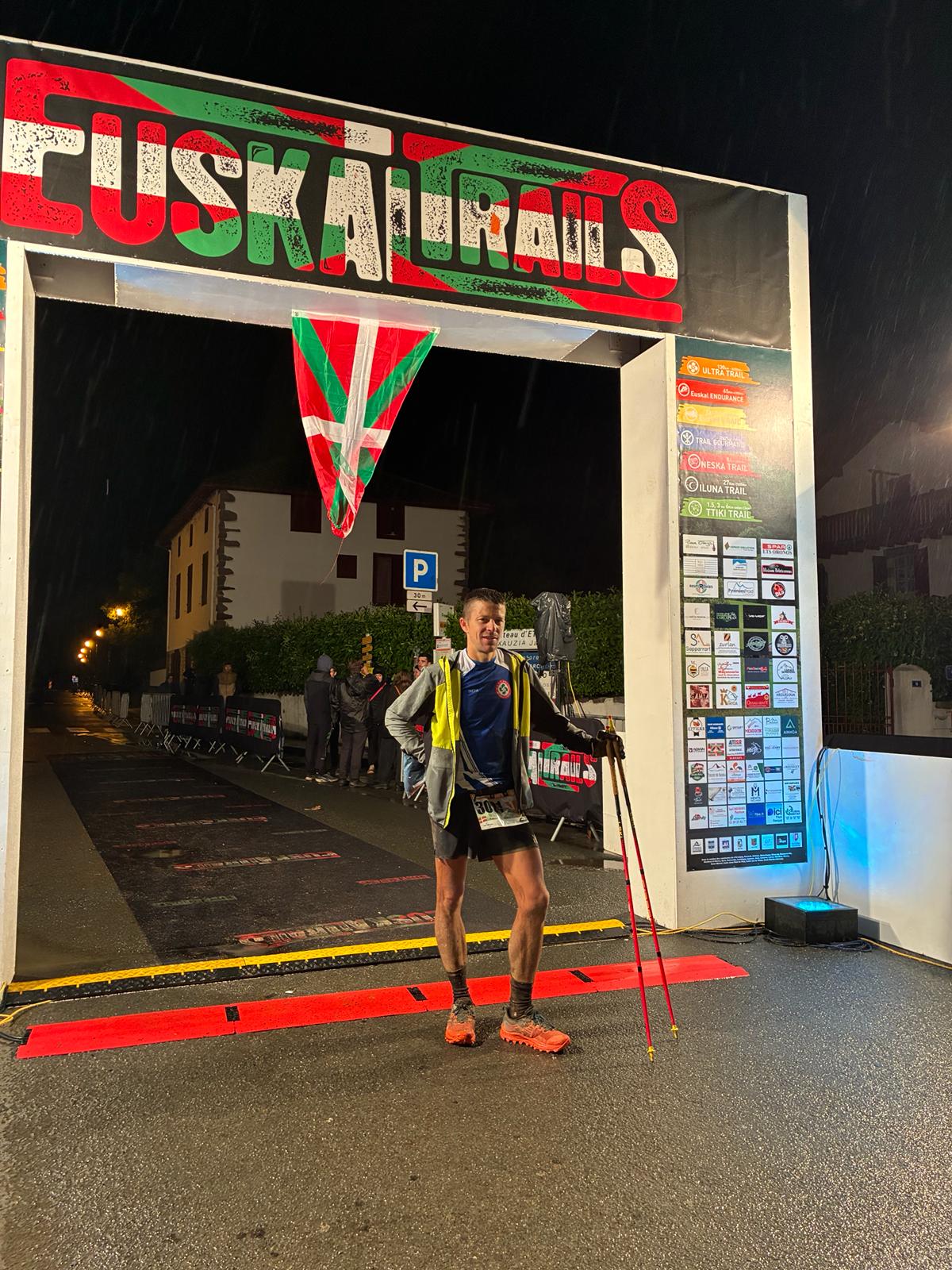
The 2026 edition on May 15 brought us unpredictable weather—high humidity and cool temperatures—with even some snow on the peaks, adding to the adventurous spirit of an ultra. The conditions were challenging but manageable, allowing runners to focus on their race strategy while staying warm.
The race started at 5 a.m., in the dark, in the rain. The first few kilometers wind through small, very damp wooded areas before tackling the first Basque ridges (Iparla).
17 checkpoints—so many milestones to measure the gap between plan and reality in ultra-trail split times. 18th overall with an average speed of 6.36 km/h—that’s the raw result. But the numbers behind this result speak volumes more than the ranking alone.
Preparing for an ultra-trail with Segly
Five days before the start, I published an article detailing how I built my strategy on Segly: importing the GPX file, dividing the route into 15 segments, and calibrating the fatigue factor. I refer you to that article for the complete methodology.
In summary: I had opted for Plan A at 9:00 p.m., with a fatigue factor of 15%. This figure meant that I planned to run the second half of the race 15% slower than the first—not out of pessimism, but as a clear-eyed acknowledgment of the reality of ultra-trail running. Segly had given me a projected finish time of 20:59. I had also prepared a Plan B for 11:00 p.m., which I shared with my support team via the app’s read-only sharing link. On May 15, at 5:00 a.m., I hit the start button. Here’s what actually happened.
The 3 Phases of the Race
You can’t understand the race by looking solely at the final result. It unfolds in three distinct phases, each with its own logic.
Phase 1 — Building Momentum (0 → 72 km, Urepel)
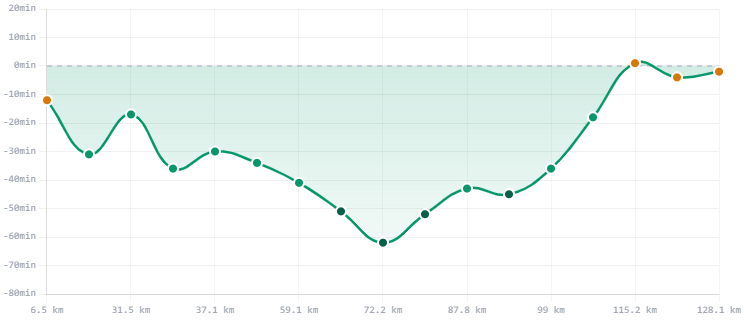
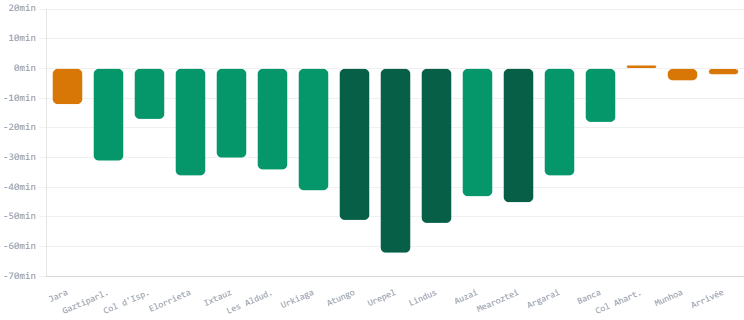
I got off to a faster start than expected. By the time I reached Jara (km 6.5), I was already 12 minutes ahead of schedule. The lead gradually grew: −31 min at Gaztiparlepoa (km 19.5), −36 min at Elorrieta, −34 min at Les Aldudes. I arrive at the Urepel checkpoint (km 72.2) 1h02 ahead of the Segly plan—this is the peak of the positive gap.
What the data reveals: on this first section, my actual trail fatigue factor was about 22%—higher than the 15% planned for a total race time of 21 hours. I was in my zone, the terrain suited me, and I capitalized on my muscles’ freshness during the first few hours.
Phase 2 — Fatigue Sets In (72 → 115 km, Col Ahartza)
From Urepel onward, the story changes. My lead melted away checkpoint after checkpoint: −52 min at Lindus (km 84.7), −43 min at Auzai, −18 min at Banca (km 108.5). At Col Ahartza (km 115.2), I’m +1 minute—back on track with the Segly plan, and even slightly ahead of it. This is the classic sign of an ultra-trail: accumulated fatigue exceeds the expected scenario. A sign that I started too fast in the first section? Probably. But it was a controlled start—not a sudden surge in pace, just a lack of vigilance over 70 km.
Phase 3 — Back on Track (115 → 128 km, Finish)
The final 13 kilometers were a surprise. The gap stabilized, my mental strength took over, and I finished just 2 minutes behind the Segly plan. A nearly perfect return to the projected times. Plan A held up despite an atypical race—and that’s the most convincing demonstration of the value of a good trail race plan.
Segly vs. Official Timing: A Segment-by-Segment Comparison
Here is the complete table of the 17 checkpoints—Segly’s projected times versus official timing:
| Checkpoint | Km | Segly Estimate | Actual Time | Difference |
|---|---|---|---|---|
| Jara | 6.5 | 1h11 | 0h59 | −12 min |
| Gaztiparlepoa | 19.5 | 3:08 | 2:37 | −31 min |
| Ispeguy Pass | 31.5 | 4:50 | 4:33 | −17 min |
| Elorrieta | 34.6 | 5:35 | 4:59 | −36 min |
| Ixtauz | 37.1 | 6:01 | 5:31 | −30 min |
| Les Aldudes | 44.7 | 6:59 | 6:25 | −34 min |
| Urkiaga | 59.1 | 9:25 | 8:44 a.m. | −41 min |
| Atungo | 62.6 | 10:17 | 9:26 a.m. | −51 min |
| Urepel ★ | 72.2 | 11:39 | 10:37 | −62 min ★ |
| Lindus | 84.7 | 1:49 PM | 12:57 | −52 min |
| Auzai | 87.8 | 2:13 PM | 1:30 PM | −43 min |
| Mearoztei | 92.0 | 2:46 PM | 2:01 PM | −45 min |
| Argarai | 99.0 | 4:14 PM | 3:38 PM | −36 min |
| Banca | 108.5 | 5:42 PM | 5:24 PM | −18 min |
| Ahartza Pass ★ | 115.2 | 6:55 PM | 6:56 p.m. | +1 min |
| Munhoa | 119.6 | 7:42 p.m. | 7:38 p.m. | −4 min |
| Arrival | 128.1 | 8:59 PM | 8:57 p.m. | −2 min |
A segment-by-segment analysis reveals several insights. The maximum lead, reached at Urepel (km 72.2) at −1h02, corresponds precisely to the halfway point. The most dramatic turnaround occurred between Banca and Col Ahartza (6.7 km): the gap went from −18 min to +1 min—the toughest segment of my race, in the middle of the night, with legs that refused to cooperate. The final climb between Munhoa and the finish line shows that my mental strength held out until the very end.
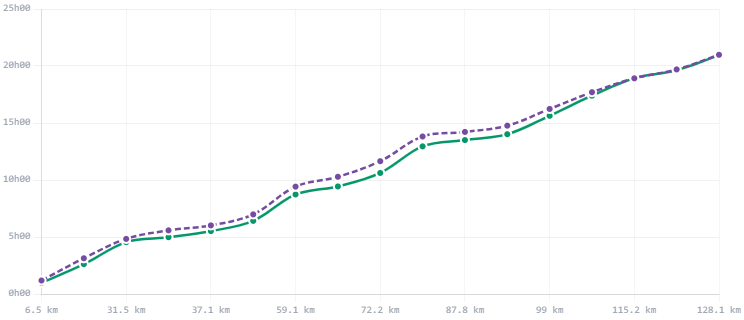
The trail fatigue factor: what the race revealed
I had planned for a fatigue factor of 15%. The reality turned out to be more nuanced—and that’s precisely what this type of analysis allows us to highlight in hindsight.
During the first half (up to Urepel, km 72), I was ahead of my estimate, thinking I could maintain the pace and finish in under 21 hours. I was slowing down less than expected—the terrain and conditions were in my favor. I took advantage of my fresh muscles to build up a substantial lead on the Segly section.
On the second half, the situation changed: fatigue crept up on me. The cool temperatures on the mountain passes, muscle fatigue, and likely a calorie deficit all took their toll. I lost most of my lead on this section.
The fatigue factor hovered around 22%—above the planned 15%, but still within a reasonable range. What’s remarkable is that the Segly plan absorbed this deviation thanks to the lead I’d built up in the first half. The final result doesn’t reflect the internal ups and downs of the race.
For my next ultra-trail training, the lesson is clear: try to stick more closely to the split times in the first half of the race, for a more controlled second half. Segly allows precisely this type of fine-tuning, segment by segment.
What Segly Taught Me About My Ultra-Trail Race Strategy
Finishing a 130 km race just 2 minutes behind a plan created 5 days earlier is rare. But the true value of Segly isn’t in the precision of the final result—it’s in the quality of the preparation that led to it.
Thanks to the segment-by-segment GPX analysis, I had concrete benchmarks throughout the race. At each checkpoint, I knew whether I was ahead or behind—and by how much. No anxiety, no improvisation—just the information I needed to make the right decisions during the race.
My support team had access to my complete plan via the Segly share link. They knew exactly where to wait for me, what to prepare for me, and at what time to start worrying if I didn’t arrive. This level of organization changes the dynamics of an endurance race.
I recommend that all runners preparing for an ultra-trail invest time in their Segly analysis before the start. Ten minutes of preparation for hours of peace of mind during the race.
The Euskal Trail 130 confirmed one thing for me: a well-thought-out race strategy makes all the difference—not just in terms of time, but in terms of the overall experience. Running with a plan means running with confidence.
Are you preparing for an ultra-trail? Import your GPX file to segly.vo2run.app, build your strategy segment by segment, and share it with your team. It’s easy, takes just 10 minutes, and can make all the difference on race day.