 SEGLY
SEGLY

134 km, 6,022 m of elevation gain, an evening start from Saugues, and a finish in bright sunshine at Le Puy-en-Velay: the Ultra du Saint Jacques 100M 2026 is one of the most challenging ultra-trails on the UTMB calendar. On Friday, June 12, at 7:10 p.m., several hundred runners will set off into the Auvergne night to reach this legendary cathedral. Here’s how to develop a race strategy to finish in 25 hours and 5 minutes—and how you can tailor this plan to your own goals.
Understanding the Course Before Developing Your Strategy
The Ultra du Saint Jacques is, above all, an extraordinary course. With 6,022 m of elevation gain and 6,335 m of elevation loss over 134.85 km (Segly data), the profile is as technical as it is demanding. But what makes this race truly unique is the combination of three factors:
- The evening start: Setting off at 7:10 p.m. from Saugues, the first 60 km are run in the dark, which requires a different pacing strategy and heightened vigilance on technical sections.
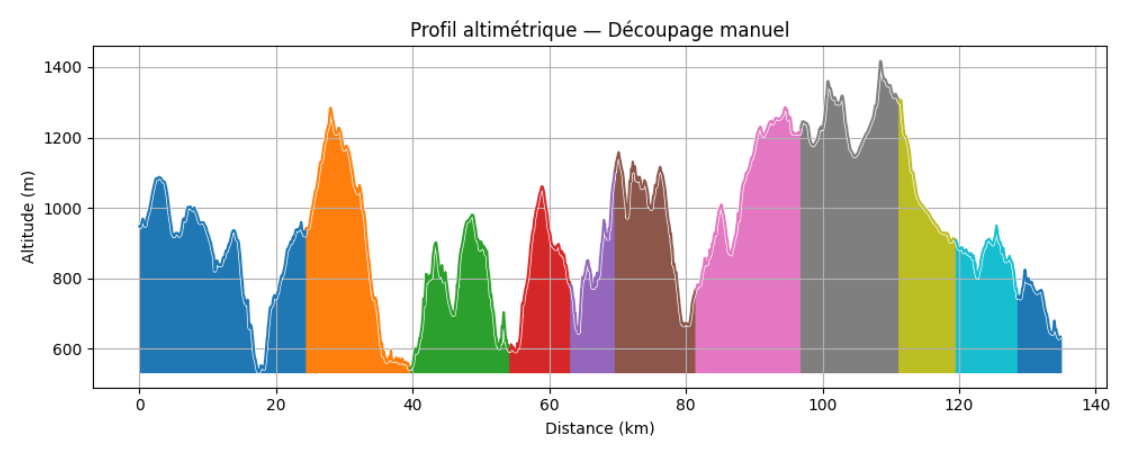
- The diversity of the segments: the course alternates between long, rolling stretches (S1, 24 km almost flat), steep climbs with significant elevation gain (S5, +5.0% average gradient over 6.5 km), and long descents toward the valley (S2, −2.6% over 15 km).
- The finish in the late afternoon: aiming for a 25-hour finish, you’ll reach Le Puy-en-Velay on Saturday around 8:15 p.m.—after racing through a full night and a full day.
The Segly breakdown reveals a course divided into three major phases: a relatively fast-paced first nighttime section (S1→S2), a gradual and sustained climb through the mountain range (S3→S7), then a gradual descent back toward the valley until the finish (S8→S11). Knowing these phases ahead of time completely changes how you manage your effort.
How I Created My Race Plan with Segly
By importing the GPX file for the Ultra du Saint Jacques 100M into Segly, the app automatically analyzes the course and suggests a breakdown into segments that take elevation gain and slope into account. I kept the course divided into 11 segments, aligned with the official aid stations and support bases.
The goal: 25 hours
25h05, or an average speed of 5.42 km/h—that’s the target I’ve set. Realistic for a runner well-trained in ultra distances, it leaves a comfortable margin before the maximum allowed time of 30h50. It’s also a flexible goal: by customizing the Segly analysis, you can aim for 22 hours, 28 hours, or any other time.
The 15% Fatigue Factor
This is the core concept behind Segly. The Fatigue Factor measures the decline in your pace between the first and second halves of the race. Here, 15% means you’ll run 15% faster in the first half than in the second. This isn’t pessimism—it’s realism.
The data confirms it: winners of major ultras like the UTMB typically have a fatigue factor of 10 to 15%. Planning for too low a factor often means starting too fast and crashing in the final segments. With 15%, you account for the night, the afternoon heat, and the muscle fatigue of the last 40 kilometers.
Key segments to watch
Not all segments are created equal. Here are the three sections that will make or break your race:
S3 — Prades → Monistrol (km 40 → 54): the muscle wake-up call
996 m of elevation gain over 14.56 km. This is the segment with the highest elevation gain in the entire race—and it takes place between 2:00 a.m. and 5:00 a.m. Running this climb at night, with the fatigue from the first third of the race already setting in, requires real discipline in maintaining your pace. Walk uphill, run on the flat sections: this is often where the second half of the race is decided.
S5 — Saint Privat → Saint Jean Lachalm (km 63 → 70): the steepest
+5.0% average gradient over 6.53 km with 668 m of elevation gain, including sections as steep as 50%—this is the most demanding segment in terms of gradient. Estimated at 1 hour and 31 minutes, this section is run at dawn (passing through Saint Jean Lachalm around 8:12 a.m.). The body is in the midst of transitioning from night to day: the ideal time to eat, drink, and manage your pace instinctively.
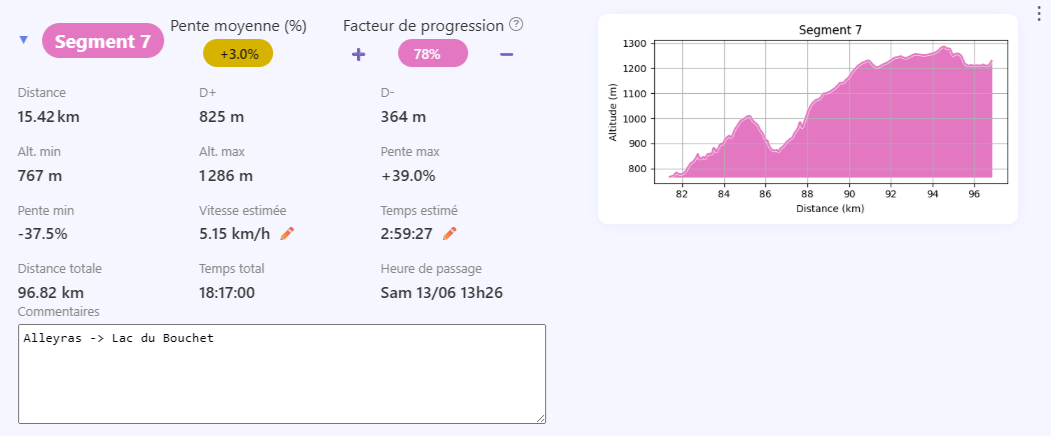
S7 — Alleyras → Lac du Bouchet (km 81 → 97): the decisive segment
15.42 km, 825 m of elevation gain, +3.0% average gradient—nearly 3 hours of effort between 10:27 a.m. and 1:26 p.m. It’s the middle of the day, and it could be hot. It’s also the point where your legs already have 80 km under them. This segment is the true litmus test: if you reach Lac du Bouchet (support station, km 97) on time, finishing the race is within reach.
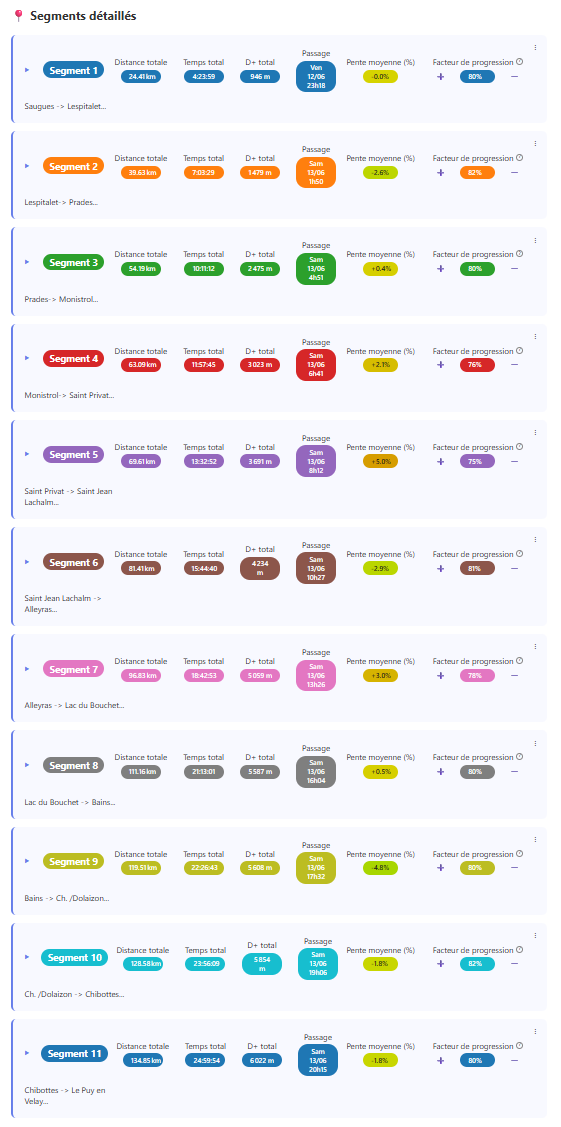
Checkpoint times to finish the Ultra du Saint Jacques in 25 hours
Here is the complete race plan for a 25:05 goal, starting from Saugues on Friday, June 12, 2026, at 7:10 p.m. This table is the ideal communication tool for your support team—if you arrive in Monistrol 30 minutes late at 5:20 a.m., the message is clear.
| Checkpoint | Km | Estimated Pass-Through Time | Type |
|---|---|---|---|
| Saugues (start) | 0 | Fri 7:10 PM | |
| Lespitalet | 24 | Fri 11:18 PM | |
| Prades | 40 | Sat 1:50 a.m. | Main Refueling Station |
| Monistrol | 54 | Sat 4:51 a.m. | Base Camp |
| Saint Privat | 63 | Sat 6:41 a.m. | |
| Saint Jean Lachalm | 70 | Sat 8:12 a.m. | Field Camp |
| Alleyras | 81 | Sat 10:27 a.m. | |
| Lake Bouchet | 97 | Sat 1:26 p.m. | Campsite |
| Bains | 111 | Sat 4:04 p.m. | |
| Ch./Dolaizon | 120 | Sat 5:31 p.m. | Main Refueling Station |
| Chibottes | 129 | Sat 7:06 PM | |
| Le Puy-en-Velay | 135 | Sat 8:15 p.m. | FINISH — 1:05 a.m. |
Build Your Own Race Strategy
The complete analysis of the Ultra du Saint Jacques 100M—the 11 segments, the 15% Fatigue Factor, the 25-hour goal—is available directly here:
View the Segly Ultra du Saint Jacques analysis — 25-hour goal →
This link gives you access to the complete read-only strategy. By clicking on “Customize the analysis,” you can:
- Change your time goal (20 hours, 22 hours, 27 hours...)
- Adjust the Fatigue Factor based on your level (10% for a very strong runner, 20–25% for a first-time ultra runner)
- Adjust the times for each segment based on your knowledge of the terrain
- Export your plan as a PDF and share your personalized link with your support team
The GPX analysis is completely free on segly.vo2run.app. No account required. 10 minutes of preparation for hours of peace of mind during the race.
Conclusion
The 2026 Ultra du Saint Jacques 100M spans 134 km with 6,000 m of elevation gain between Saugues and Le Puy-en-Velay—an adventure that only thorough preparation can turn into a success. A solid ultratrail race plan, realistic split times, and a well-informed support team: the ingredients are simple, but they make all the difference when your legs start to feel heavy between Bains and Le Dolaizon.
On Friday, June 12, 2026, at 7:10 p.m., headlamps will come on in Saugues. In 25 hours (or a little more), the cathedral in Le Puy-en-Velay awaits you. Create your plan, share it with your team, and run with confidence.
Ready to create your race plan for the 2026 Ultra du Saint Jacques? Access the Segly analysis shared at segly.vo2run.app/pages/partage.html?id=25 and customize it with a single click—it’s free.