 SEGLY
It's the question every trail runner asks sooner or later. You come back from a long run exhausted, unable to train the next day. Or, on the contrary, you feel you haven't done enough. The long run is the cornerstone of any trail preparation — but poorly dosed, it can wreck an entire week of training. Here's how to calibrate it.
Why is the long run essential in trail running?
The long run isn't just a way to rack up kilometres. It drives deep physiological adaptations that shorter sessions can't produce:
Developing fat utilisation. By sustaining a long effort at low intensity, the body gradually learns to use fat as its main fuel. This is essential in ultra-trail: carbohydrate stores run out within a few hours, while fat reserves are virtually unlimited. The more you train this system, the later you start to "dig into the muscle".
Adapting tendons, ligaments and postural muscles. The cardiovascular system adapts within a few weeks. Tendons and ligaments take several months. The long run is irreplaceable for getting the body used to absorbing hours of repeated impact on varied terrain.
Mental resilience. Holding a pace for 3, 4 or 6 hours requires effort management that short sessions don't teach. The long run is also mental training.
The most common mistake: running too fast
70% of amateur runners spend their time in the "grey zone": too fast to develop the aerobic base, too slow to stimulate the threshold. They accumulate fatigue without building adaptation. They stagnate.
The long run should be run slowly. Genuinely slowly. Slower than you think intuitively. And that's precisely where the most common error lies: going out too fast on the grounds that "it's pointless if it's too easy".
If you finish your long run exhausted, you went too fast. That's not a productive long run — it's a disguised threshold session, with all the recovery damage that comes with it.
The target zone: fundamental endurance
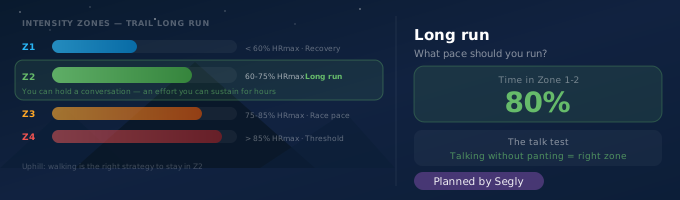
Fundamental endurance corresponds to 60 to 75% of your maximum heart rate. It's an easy pace, almost too easy: you should be able to talk without getting out of breath, breathe steadily, and finish your run without excessive fatigue.
The simplest test: conversation. If you can hold a full conversation without getting breathless, you're in the right zone. If you have to stop to catch your breath, you're already too high.
In trail running, one extra marker applies: on climbs, walking is often the only way to stay in fundamental endurance. It's not a weakness — it's strategy. The world's best ultra-trail runners walk the climbs on long runs. What matters is time on your feet and overall effort management, not instantaneous speed.
The 4 pace zones and their role on a long run
Understanding effort zones helps give meaning to each type of session:
Zone 1 — Active recovery (< 60% HRmax)
Very easy, almost a jog. Ideal for recovery runs after a race or a heavy week. Useful on long runs across flat sections after a tough climb.
Zone 2 — Fundamental endurance (60–75% HRmax)
This is the queen zone of the long run. 80% of training time should be done in Zones 1–2. Easy conversation, low to moderate perceived effort. You can hold this pace for a very long time.
Zone 3 — Specific pace (75–85% HRmax)
Close to race pace over shorter formats. Useful late in a long run to simulate end-of-race fatigue, or on structured portions. To be used with care.
Zones 4–5 — Threshold and above (> 85% HRmax)
Reserved for specific quality sessions. Has no place in a classic long run, except for a very targeted effort over a short portion.
How long should your long run be?
Basic rule: the long run represents 25 to 35% of weekly volume. If you run 6 hours a week, your long run should be between 1h30 and 2h.
For a 20–30 km trail, the progressive long run reaches 2h to 2h30 in fundamental endurance at peak preparation.
For a 50–80 km trail, the base long run should progressively reach 3h to 3h30 in fundamental endurance. Mid-preparation, a progressive hilly run of 2h30–3h with D+ brings more specificity than a longer flat run.
For an ultra-trail over 100 km, long runs regularly exceed 4h to 5h, in "hike-run" formats that include active walking and breaks. The key weekend — two consecutive outings on Saturday and Sunday — becomes a central tool of preparation.
The special case of the mountains: forget the pace, go by heart rate
In trail running, speed in km/h means nothing on its own. On a climb at 20% gradient, even walking can push your heart rate above 80% HRmax. The reverse is true on descents: you can go fast while staying in fundamental endurance.
The key is to accept adapting your pace. On climbs, walking is often the only way to stay in the fundamental zone. On descents, speed can be high while heart rate stays low, which fits fundamental endurance well.
Your heart rate, not your watch, is the right reference. If you don't have a heart rate monitor, your feelings are enough: the conversation test remains the best free tool for controlling intensity.
Long run vs recce vs key weekend: what's the difference?
These three formats serve different goals, even though they share the same duration and intensity zone:
The classic long run builds the aerobic base and general endurance. It's repeated every week or every 10 days throughout preparation.
The course recce has an additional tactical goal: learning the terrain of your target race. It's run at a very conservative pace to save energy and stay clear-headed on the course.
The key weekend chains two consecutive outings — often shorter than the usual long run — to simulate the accumulated fatigue of an ultra. This format develops resistance to accumulated fatigue, an essential quality in ultra-trail. The second outing, on heavy legs, is often more formative than the first.
Segly and Training Mode: your paces calculated on your real GPX
Knowing effort zones in theory is good. Applying them to your real course, with your segments and your specific elevation gain, is much better.
That's exactly what Segly's Training Mode does. You import the GPX of your long run or your recce, select the pace zone that matches your goal for the day, and Segly generates estimated times segment by segment — calibrated to your ITRA, UTMB Index or BeTrail level, and adjusted for the forecast weather.
The 4 zones available in Training Mode:
- Fundamental endurance — the default choice for the long run. Easy pace, conversation possible, effort you can hold for hours.
- Recovery — even more conservative. Ideal for runs the day after a race or a very heavy week.
- Specific pace — close to your race pace. Reserve it for targeted sessions mid-preparation, not for classic long runs.
- Threshold / tempo — automatically disabled beyond 2 hours of running. Segly stops you making a dosing mistake without you noticing.
In short: the golden rules of the long run
- The long run is run slowly — in fundamental endurance, between 60 and 75% of your HRmax. Conversation must stay possible from start to finish.
- On climbs, walking isn't a fallback option: it's the correct strategy for staying in the right zone.
- The duration depends on your race goal — from 2h for a short trail to 5h and more for an ultra — but it should never represent more than 35% of your total weekly volume.
- If you finish exhausted, you went too fast. A successful long run is recognised by the fact that you still have energy left to keep going.
Preparing a long run or a recce? Import your GPX on segly.vo2run.app, select Training Mode and choose your pace zone. Segly gives you split times segment by segment, adapted to your level and to the day's weather.