 SEGLY
SEGLY
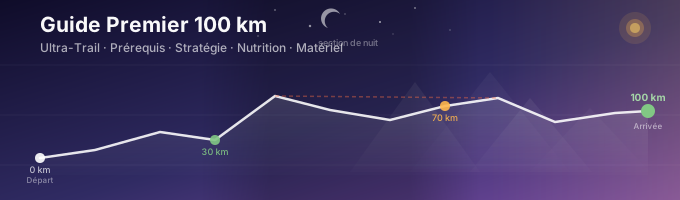
One hundred kilometers. Two words that make your stomach churn. A distance that’s as fascinating as it is intimidating, one that seems to belong to others—the people you see in magazines, not you. And yet, here you are, considering taking on this challenge.
That’s what this guide is for. Not to promise you it’ll be easy—it won’t be. Not to fill you with lofty speeches about pushing your limits. Just to give you, in practical terms, the keys to preparing for your first 100 km ultra-trail: start informed, run with a plan, and cross the finish line on your feet. The distance is long, and mistakes are costly—so you might as well start with the right tools in mind.
Am I ready for a 100 km race?
That’s the first honest question you should ask yourself. Enthusiasm is a great reason to sign up for an ultra—but it’s not enough to finish it. Here are the realistic prerequisites for tackling your first ultra-trail under the right conditions:
- Solid mileage base: You’ve been running 50 to 60 km per week, consistently, for at least six months. This isn’t just a suggestion—it’s the absolute minimum your body needs to handle the specific training that follows.
- Experience with long-distance running: You’ve completed at least one 50 km mountain race, or two races of 30 km or more on technical terrain. Without this, the 100 km race will present surprises you aren’t prepared to handle.
- Proficiency in fast walking: On a 100 km race with 4,000 m of elevation gain, you’ll be walking for hours. Knowing how to walk quickly and efficiently uphill—ideally with poles—is a real skill that takes practice.
- Experience running at night: Almost every 100 km race includes a full night. If you’ve never run with a headlamp, start there before signing up.
Choosing Your First 100-km Race
Not all races are created equal when it comes to your first ultra-trail. Here are the non-negotiable criteria:
- Reasonable elevation gain: stay under 5,000 m D+. Between 3,000 and 4,500 m is the ideal range for a first ultra—challenging enough to feel like a real race, but not so much that it destroys you.
- Frequent aid stations: every 15 to 20 km. This limits the amount of food you need to carry, provides psychological checkpoints, and allows your support crew to assist you effectively.
- Good organizational reputation: clear course marking, on-site medical support, and clear communication. Trail running forums and online reviews are your best indicators.
- Generous time limit: at least 30 hours. For a beginner, a cutoff that’s too tight is an unnecessary source of stress—and often a reason to drop out.
- Accessible terrain: Avoid high-altitude races (over 2,500 m) and ultra-technical courses. Save those for when you’ve got one or two ultras under your belt.
These are approximate figures—check the official websites before registering.
| Race | Location | Km | Elevation Gain | Time Limit | Difficulty |
|---|---|---|---|---|---|
| Trail des Templiers 100 | Millau (34) | ~107 km | ~4,200 m | 30 hours | ★★☆☆☆ |
| Punisher 100 | Vercors (38) | ~102 km | ~4,500 m | 32 hours | ★★☆☆☆ |
| Terranimo 100 | Hérault (34) | ~100 km | ~3,800 m | 32 hours | ★★☆☆☆ |
| Outdoor Trail Morvan 100 | Burgundy (58) | ~105 km | ~3,200 m | 33 hours | ★★☆☆☆ |
| Ardéchoise 100 Trail | Ardèche (07) | ~100 km | ~4,000 m | 30 hours | ★★☆☆☆ |
Physical Training: What You Really Need to Do
Preparing for a 100 km race isn’t about running more—it’s about running smarter. Here’s how to structure your last six months before your first ultra-trail.
Base Volume (3–4 months out)
Gradually build up to 60–70 km per week, incorporating elevation gain if your target race is in the mountains. Include long runs of 4 to 5 hours, even at a slow pace—what matters is time on your feet, not speed. Alternate between heavy weeks (80–90% of target volume) and lighter weeks (60–70%). Consistency over time beats isolated peaks.
The Specific Phase (6–8 weeks before)
This is the phase where you simulate the real pain of an ultra. Schedule one ultra-long run of 7 to 8 hours, ideally 4 to 6 weeks before the race—just one is enough. Work on weekend training blocks: a long run (5–6 hours) on Saturday, followed by 2 to 3 hours on Sunday with tired legs. Also practice fast walking uphill with poles: this is a technique that takes time to master and can give you a significant advantage in an ultra.
Recovery (3–4 weeks before)
Gradually reduce your training volume: −20% in the fourth week before the race, −30% in the third, −40% in the second. Maintain intensity during short sessions to keep your form sharp, but let your body absorb the accumulated work. This is when you’re building your true reserves for race day.
The week before
No long runs. Just two to three light jogs of 30 to 45 minutes—that’s it. Get your gear ready five days before the race, check your list, and verify your race number. This is also the perfect time to finalize your race strategy: import your GPX file, calculate your split times, and prepare your information sheet for race support.
Developing Your Race Strategy
Strategy is what separates those who finish on their feet from those who collapse at the 75 km mark. And the number one reason for dropping out of a first 100 km trail race is invariably the same: starting too fast.
The first few hours of an ultra are treacherous. You feel great, the adrenaline is pumping, and everyone else seems to be flying. If you give in to that temptation, you’ll pay the price between km 60 and km 80—and it’ll be steep.
The concept of the fatigue factor. In an ultra, your pace declines as the hours go by. This isn’t a failure—it’s a physiological reality. A 20% trail fatigue factor means you’ll run 20% slower in the second half than in the first. For a beginner in ultra-trail running, factoring this into your race plan is crucial. Planning for a decline in pace means planning for a successful finish.
Break your course down into aid stations. Each aid station is an intermediate goal, a psychological marker, and a checkpoint for you and your support crew. Calculate your estimated time at the 100-km mark for each one, taking into account elevation gain, altitude, and your gradual decline in pace. This race plan is what you’ll give to your support team.
The Importance of a Race Plan. Your support team needs to know where you’ll be and at what time. A realistic race plan is also a stress-management tool on race day: if you arrive at a aid station early, you know you need to slow down; if you’re late, you know it’s expected—and therefore manageable.
Nutrition for a 100 km Run: The Basics
In an ultra, you don’t just run on your legs—you run on your stomach. Nutrition in ultra-trail running is often the limiting factor that runners underestimate the most.
The rule of thumb: at least 250 to 300 kcal per hour. Below that, you’ll create an energy deficit that will eventually bring you to a sudden halt—in the form of a sudden hunger pang or a mental slump between two mountain passes.
Alternate between solid and liquid foods to avoid overloading your digestive system. Practice eating while running several weeks before the race. Never try a new product on race day. At aid stations, don’t linger: 5 to 10 minutes maximum. And what about the “night soup”? Irreplaceable—hot broth, salt, comfort—it’s often what gets you going again when everything seems to have come to a standstill.
| Phase | Distance | Recommended Nutrition | Frequency |
|---|---|---|---|
| Phase 1 | 0–30 km | Gels, bars, bananas, electrolyte drinks | Every 45 min |
| Phase 2 | 30–70 km | Alternate between solid and liquid foods: soup, rice, white bread | Every 30–40 min |
| Phase 3 | 70–100 km | Hot broth, easily digestible solid foods, sugary drinks | Every 20–30 minutes |
Mandatory and Recommended Gear
The list of mandatory ultra-trail gear varies by race—always check the official rules for your event. Here’s what you’ll almost always find:
Generally mandatory gear:
- Trail running backpack with a water reservoir (at least 1.5 to 2 L)
- Headlamp with spare batteries
- Emergency blanket
- Waterproof, windproof jacket
- Charged phone with the GPX route downloaded offline
- Whistle
- Basic first-aid kit (bandages, gauze pads, Strappal)
- Regulatory food supply
Recommended gear for your first 100 km:
- Second headlamp (as a backup)
- Blister patches (Compeed, Fixomull)
- Vaseline or anti-chafing cream
- Compression sleeves (calves)
- Down jacket or lightweight warm jacket for the night
- Hat and gloves
- Spare shoes and socks to leave with support staff
- Power bank to charge your phone
The Night: The Real Challenge of the 100 km
People don’t tell you this often enough: the night is the true test of an ultra-trail. Almost every 100 km race includes a full night—sometimes more. And that night will test your mind just as much as your legs.
Fatigue peaks between 2 a.m. and 5 a.m. That’s when dropouts start piling up—not because of your legs, but because your morale falters, everything seems absurd, and the urge to stop becomes tempting. This slump is predictable. Knowing this won’t make it go away, but it will help you get through it.
Train at night before the race. One or two night runs during your preparation will help you get used to your headlamp, the sudden cold, and the disorientation caused by the lack of visual landmarks. Running at night requires preparation.
The tactical nap. If you feel yourself becoming a danger—drowsiness, micro-sleeps, mild hallucinations—a 15- to 20-minute nap at a aid station can transform the second half of your race. It’s not giving up; it’s managing the race intelligently.
And then there’s sunrise. Magical and universal. Energy returns out of nowhere; the landscape lights up. Hang in there until dawn—it changes everything.
Race Day: What to Do (and What Not to Do)
✓ Do:
- Start near the back of the pack—your ego will thank you at the 80 km mark
- Eat your first snack right from the start, before you get hungry
- Carry your printed split-time sheet with you, and keep a copy with your support team
- Wear only clothing and gear that you’ve tested and broken in
- Drink regularly, even if you’re not thirsty
- Smile at the volunteers—it’s free fuel
✗ Don’t:
- Don’t run with the fast groups at the start—you’ll see them again later when they’re struggling
- Don’t sit for more than 10 minutes at a aid station (your legs will stiffen up)
- Trying out a new energy gel, a new pair of shoes, or a new energy bar on race day
- Trying to make up lost time by speeding up in the first half
- Panicking when night falls—you’ve prepared for it, and it always passes
- Sitting down without setting a strict time limit
Conclusion: Finishing on your own two feet is already a victory
Your first 100 km won’t be perfect. There will be moments of doubt, urges to quit, cramps, and climbs that seem to go on forever. That’s what an ultra-trail is all about—and that’s precisely why crossing the finish line will remain one of the greatest things you’ve ever done. The distance is long. Finishing on your feet is a victory, no matter what time it is.
Prepare thoroughly, strategize smartly, and respect your race. Every kilometer you manage well in the first half will pay off as you stay on your feet for the final 20.
To build your ultra-trail race strategy and calculate your split times segment by segment, import your GPX file to segly.vo2run.app. Set your fatigue factor to 20% for the first 100 km, generate your race plan, and share it with your support team. It’s easy, takes 10 minutes—and can make all the difference on race day.